
Product guidance
Beyond Database Constraints: Preventing Duplicate User Registrations with Verification Workflows
Learn how combining database unique constraints, atomic operations, and metadata verification supports preventing duplicate user registrations.
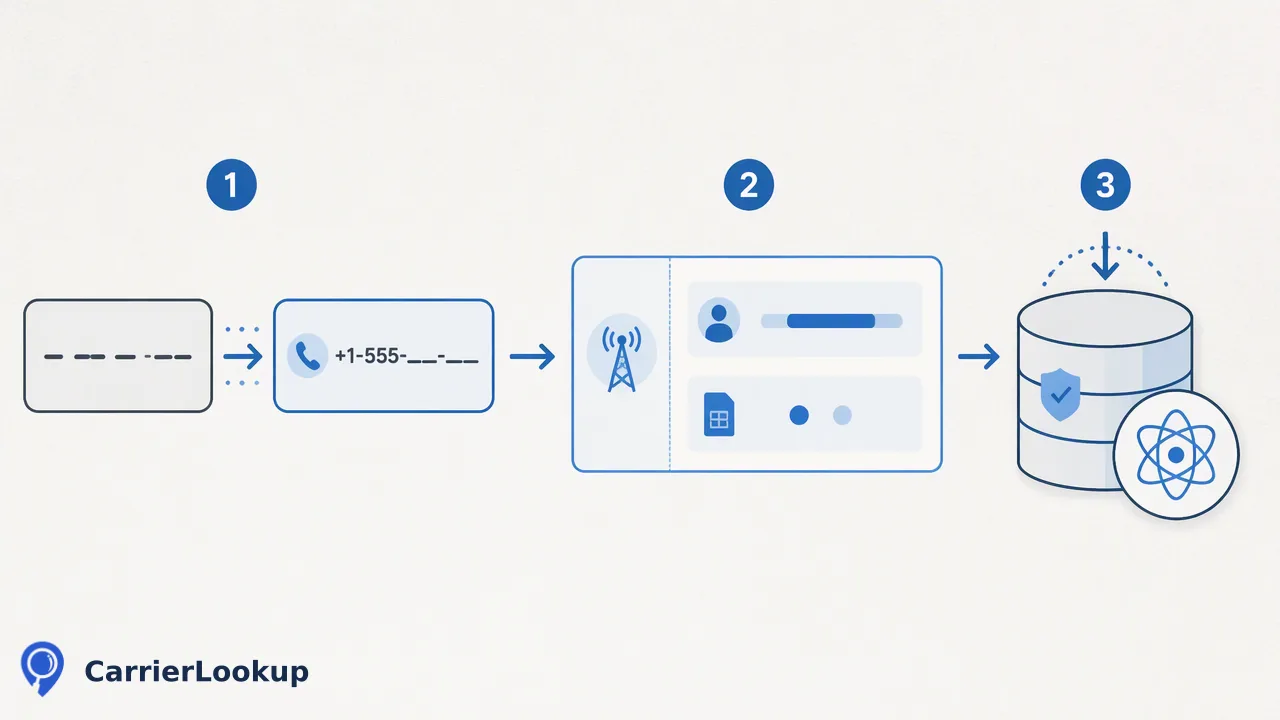
A practical guide on preventing duplicate user registrations by pairing database unique constraints and atomic operations with pre-flight E.164 normalization and original carrier allocation metadata.
Preventing duplicate user registrations requires a multi-layered architecture that pairs database-level storage constraints with application-level data verification. Database unique constraints act as the final structural line of defense against redundant records, but relying solely on database errors creates operational friction during high-concurrency onboarding. By introducing pre-flight validation—such as E.164 phone formatting and original carrier allocation metadata checks—engineering teams filter malformed or noisy inputs before database execution. This combined workflow manages race conditions through atomic transactions, reduces backend exceptions, and supports long-term data integrity across production user registries.
The Multi-Layered Architecture for Registration Integrity
A resilient registration pipeline separates concerns between application-level ingestion and storage-layer persistence. Application-level verification inspects incoming contact information, standardizes string formats, and gathers telemetry before executing state changes. This preliminary layer reduces unnecessary database round-trips and catches common input errors early in the user lifecycle.
Database unique indexes serve as an immutable barrier against duplicate identities. Even when application processes pass initial validation, concurrent submissions targeting the same identifier can slip past standard read queries if isolation levels are weak. Relying exclusively on application logic risks integrity failures under load, while relying purely on database constraints forces downstream services to handle noisy database exceptions. Integrating both approaches creates a balanced pipeline where application checks optimize throughput and database constraints maintain structural uniqueness.
Implementing Storage Constraints and Atomic Operations
At the database layer, defining unique constraints on primary identifiers like normalized phone numbers or emails forms the bedrock of data consistency. When multiple registration workers attempt to write the same identifier simultaneously, the database engine uses index structures to enforce uniqueness.
To streamline registration logic and minimize round-trip overhead, teams frequently implement atomic database operations such as INSERT ... ON CONFLICT or UPSERT patterns. Atomic execution evaluates existence and persistence within a single statement, closing the gap between read and write operations where race conditions occur. When a duplicate key conflict arises, the engine returns a predictable constraint violation rather than generating corrupt state. Handling these conflicts gracefully in application code supports clear feedback to the user while keeping the database clean.
Reducing Pipeline Noise with Pre-Flight Metadata Checks
Before records reach database insertion routines, pre-flight data sanitization filters out formatting anomalies and structural inconsistencies. Normalizing input strings into standard formats, such as ITU-T Recommendation E.164, ensures that phone numbers share a consistent international format with a leading plus sign, country code, and subscriber digits. This standardization resolves superficial discrepancies, such as local trunk prefixes or punctuation differences, that could otherwise bypass basic string comparisons.
Teams can further enrich this pre-flight phase by reviewing original carrier allocation metadata through CarrierLookup's synchronous POST /api/v1/check endpoint. This check returns allocation geography, line type, and the originally assigned network for an E.164 identifier. Because allocation context remains static regardless of subsequent porting, it provides technical baseline details about number blocks. Incorporating allocation signals into early validation stages helps systems categorize incoming registration traffic and organize routing rules before persisting records to storage.
Managing Concurrency and Race Conditions
In high-concurrency systems, handling simultaneous registration attempts presents distinct performance trade-offs between pre-flight queries and exception management. A common architectural issue involves issuing a pre-flight SELECT query to test whether a user identifier exists, followed by a conditional INSERT. In distributed or multi-threaded environments, two concurrent requests can both execute the read check successfully before either performs the write, triggering race conditions.
Balancing read checks against exception handling requires deliberate architecture. While lightweight pre-flight filtering discards malformed payloads before touching primary tables, the persistence step must treat the database unique constraint as the authoritative arbiter. Engineering teams should design the registration service to catch unique index violation exceptions explicitly. By translating database conflict errors into clean domain events or status codes, the service maintains high throughput without locking tables or corrupting account relationships.
FAQ
Why are database unique constraints alone insufficient for preventing duplicate user registrations?
Unique constraints reliably stop duplicate database rows, but they act only at the end of the transaction lifecycle. Depending entirely on database collisions forces the storage engine to process malformed, unstandardized, or noisy records. Integrating pre-flight normalization and metadata verification upstream reduces unneeded database load, standardizes input variations, and lets teams resolve validation issues before database errors occur.
How does original carrier allocation metadata inform registration workflows?
Original carrier allocation metadata provides static network assignment context, line type, and regional numbering geography for an identifier. By querying this allocation data through synchronous checks, engineering teams gain structural context on the phone number range. This context supports automated traffic triage and internal routing decisions alongside primary database validation.
What is the role of E.164 normalization in data integrity?
Number normalization converts phone numbers into the standardized format specified by ITU-T Recommendation E.164, comprising a country code and up to fifteen digits. Normalization prevents duplicate entries caused by inconsistent user inputs, such as extra spaces, dashes, or national prefixes, ensuring identifiers match consistently against unique database constraints.
Learn More
Choose the product information that fits the next step in your workflow.