
Product guidance
Privacy-First Phone Verification: A Guide to GDPR and Data Compliance
Learn how to maintain phone verification data compliance under GDPR using data minimization, original allocation signals, and privacy-first workflows.
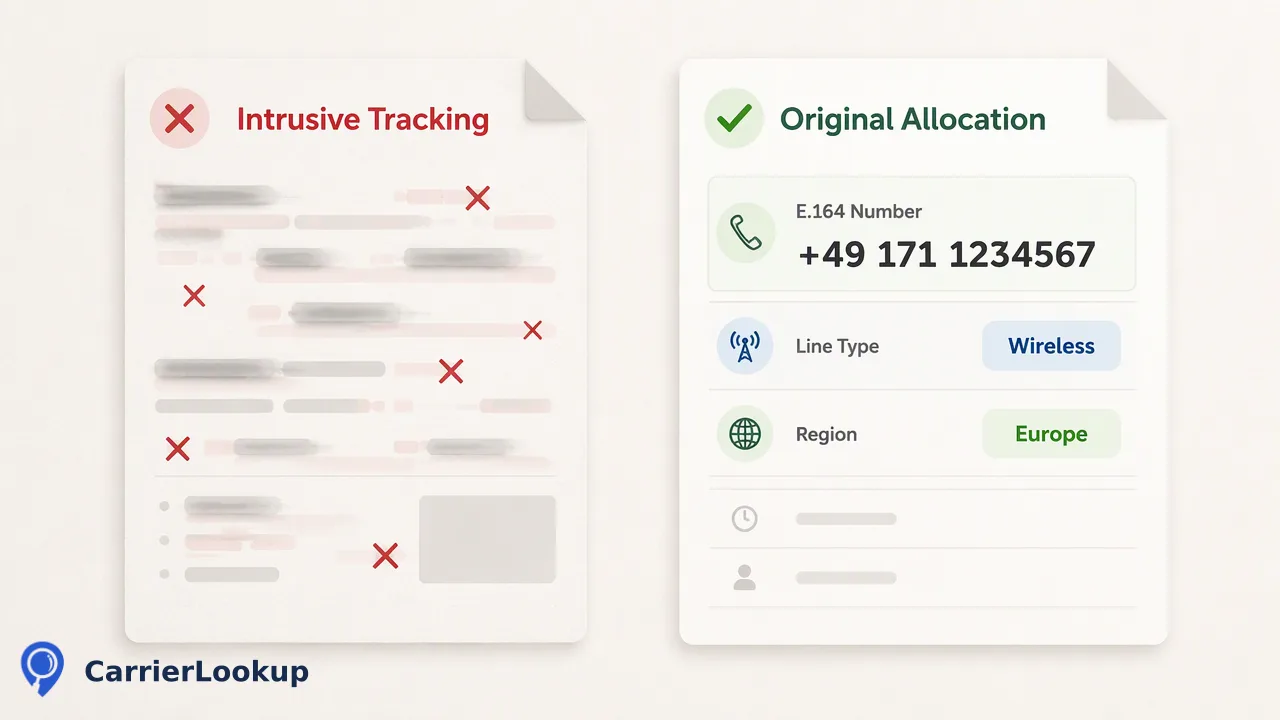
A practical guide to maintaining phone verification data compliance under GDPR, using data minimization, original allocation signals, and privacy-first workflows.
Privacy-first phone verification relies on data minimization—collecting only the metadata necessary for a specific business purpose. Under regulatory frameworks like GDPR Article 5 (Regulation (EU) 2016/679), organizations handling phone numbers must ensure that processing remains adequate, relevant, and strictly limited to what is necessary. By evaluating original carrier allocation, line type, and numbering geography rather than deploying intrusive real-time tracking, teams can inform routing, segmentation, and risk review workflows without collecting personal identity records or live device telemetry. This privacy-conscious approach supports regulatory compliance, reduces data exposure risks, and creates defensible verification pipelines.
The Principle of Data Minimisation in Verification
Maintaining phone verification data compliance begins with understanding core privacy obligations. Under GDPR Article 5 (Regulation (EU) 2016/679), personal data must be adequate, relevant, and limited to what is necessary for the purposes for which it is processed.
When organizations collect phone numbers for account security or communication, traditional verification processes often capture excessive data. Querying consumer credit databases, pulling full subscriber identity records, or accessing mobile device telemetry introduces severe compliance burdens and expands an organization's attack surface.
Data minimization requires engineering teams to re-evaluate what signals are genuinely required. Many operational decisions—such as filtering out VOIP numbers or routing international calls—only require numbering attributes. Standardizing inputs according to ITU-T Recommendation E.164, which defines numbers with a country code and up to 15 digits, enables teams to validate numbering syntax and query essential allocation context without gathering surplus personal identifiers.
Original Allocation vs. Real-Time Tracking
A critical distinction in privacy-safe architecture is the difference between original carrier allocation and real-time behavioral tracking.
CarrierLookup provides original carrier lookup for phone-number workflows by returning the carrier a number was originally allocated to, along with line type and allocation geography. This dataset provides structural context regarding the phone number's assigned range. Importantly, as outlined by the FCC in Porting: Keeping Your Phone Number When You Change Providers, consumers frequently port numbers between wireline, wireless, and IP providers while retaining their digits.
Original allocation does not track post-porting carrier movements, nor does it track real-time subscriber location. Region and city attributes represent geographic numbering assignments, not GPS coordinates or physical device whereabouts. Crucially, original carrier lookup is not a reachability check. Relying on static allocation signals gives teams valuable infrastructure context while avoiding the intrusive regulatory implications of live tracking technologies.
Architecting Workflows for Data Compliance
To maintain regulatory alignment, organizations should structure technical workflows so that each external lookup serves a defined, documented purpose.
| Signal Type | Privacy Footprint | Operational Workflow Role |
|---|---|---|
| Original Carrier | Low (Numbering Plan Metadata) | Informs carrier routing decisions |
| Line Type | Low (Structural Metadata) | Flags VOIP vs. mobile vs. wireline |
| Allocation Geography | Low (Range Assignment) | Informs regional dial-code formatting |
| Device Telemetry | High (Subscriber Tracking) | Excessive for basic verification |
Technical implementations can integrate CarrierLookup through single synchronous checks via REST API or evaluate entire datasets asynchronously. When processing synchronous batches, fields such as carrier, underlying_carrier, number_type, and allocation geography provide clear signals, while unassigned values return empty strings. Rather than maintaining long-term data lakes of phone metadata, organizations should implement strict data deletion schedules, purging lookup outputs once the routing or risk review decision has been recorded.
Transparency, Consent, and Verification Governance
Phone verification data compliance requires clear governance around user consent and notification. Even non-intrusive metadata checks must align with transparent privacy notices that outline how user data is evaluated during registration or account onboarding.
Organizations must establish a lawful basis for phone processing. When telephone outreach or SMS communication is planned, companies remain responsible for securing appropriate user consent. Compliance teams should avoid assuming that an available phone number carries implied communication rights.
Embedding compliance into identity workflows serves as a competitive advantage. Companies that respect data minimization build stronger customer trust, reduce exposure to regulatory fines, and avoid the complex liabilities associated with storing sensitive behavioral data. Integrating privacy-preserving telecom context helps organizations meet operational goals while upholding robust data protection standards.
FAQ
How does original carrier allocation support data minimization?
Original carrier allocation supports data minimization by providing network and line-type context without requesting subscriber records or tracking device behavior. It informs technical routing and review processes using telecommunication numbering data rather than collecting personal identity files, location telemetry, or persistent behavioral tracking metrics.
Is phone number metadata considered personal data under GDPR?
Yes, phone numbers are generally classified as personal data under GDPR because they can identify an individual either directly or when combined with other identifiers. While allocation metadata describes telecommunication numbering plans, processing associated phone numbers requires a clear lawful basis, purpose limitation, and documented retention controls.
Why should organizations avoid using carrier lookup as a reachability check?
Original carrier lookup returns the operator to which a number was originally allocated, rather than live network registration or current carrier status after porting.
Learn More
Choose the product information that fits the next step in your workflow.