
Why Prospect Phone Numbers from Contact Data Tools Are Inaccurate
Inaccurate prospect phone numbers often reflect a data-handling problem before they reflect anything about the person: missing country context, malformed f
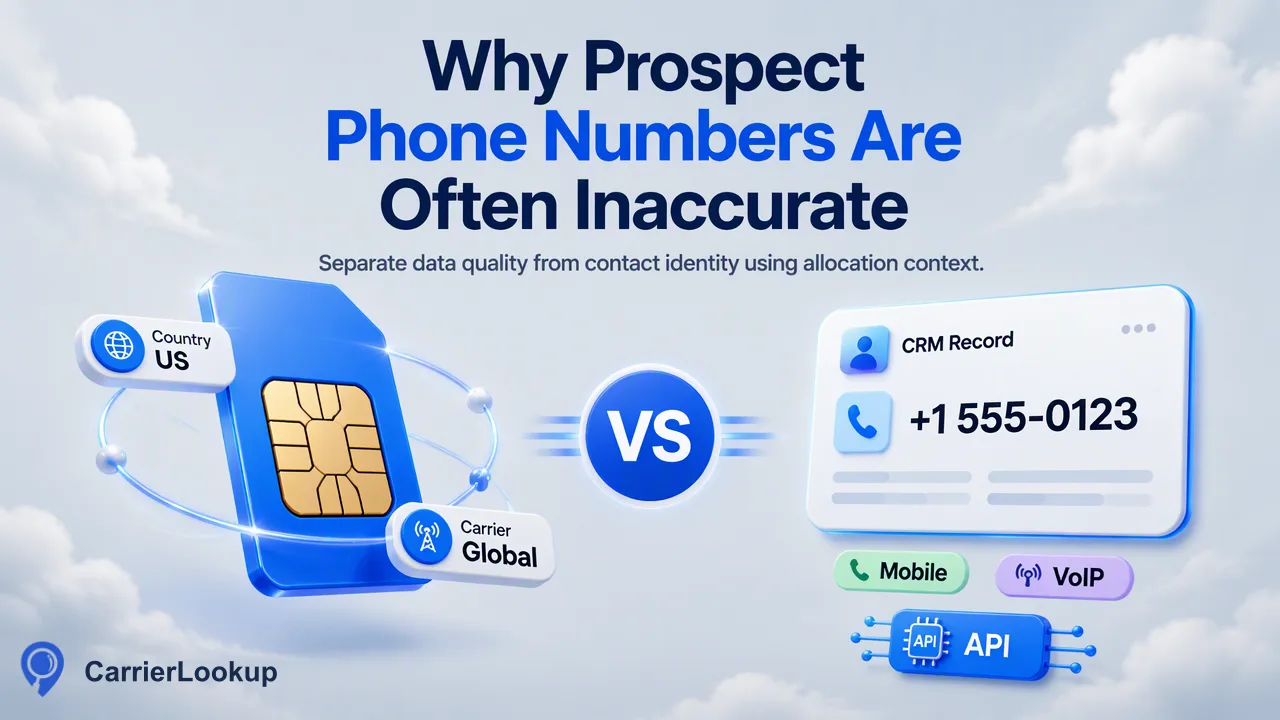
Inaccurate prospect phone numbers often reflect a data-handling problem before they reflect anything about the person: missing country context, malformed formatting, stale contact records, or confusion between mobile and fixed lines.
Inaccurate prospect phone numbers often reflect a data-handling problem before they reflect anything about the person: missing country context, malformed formatting, stale contact records, or confusion between mobile and fixed lines. An original carrier lookup can add allocation context to a review queue. It cannot establish that the prospect currently uses, owns, or can receive messages at the number.
Separate data quality from contact identity
A sales operations team may import numbers from several contact data tools, CRM forms, and older spreadsheets. Some values are local dialing strings without a country code. Others contain spaces, trunk prefixes, or labels that were lost during export. A contact record can also be old or attached to the wrong organization. Before blaming a lookup service for a mismatch, compare the stored source field with the original record and the country the source claimed.
The first useful question is whether the number is represented in a form the team can interpret consistently. E.164 provides an international numbering structure with a country code and national number; the ITU recommendation is the primary reference. For CarrierLookup realtime input, use a leading plus sign, country code, and subscriber number with no spaces or separators. A rejected format is not a finding that the number has no carrier.
Keep the provenance of each imported phone field. Record the source, date, claimed country, and any normalization step. This helps analysts distinguish a transformation error from a true inconsistency in the original dataset. A number should not be silently rewritten using a guessed country code, especially when a dataset spans several markets.
Use allocation fields as context, not a person match
CarrierLookup provides the originally allocated carrier, underlying carrier, number type, country code, region, and city allocation fields where available. These fields describe number-range allocation context. The carrier field is the carrier to which a range was originally allocated. It is not necessarily the carrier currently serving a number after portability. Region and city describe allocation geography, not the present location of a person or device.
For a prospect list, those fields can help find records that warrant human review. A number labeled mobile in the CRM but returned with a different number type may need a source correction. A country code that differs from a team's target market may indicate that the CRM's country field is stale. An empty optional field should be recorded as unavailable, not converted into a negative verdict. A completed code=0 lookup can still have empty carrier fields.
The lookup does not tell whether the number is active, reachable by voice or SMS, or associated with the named prospect. Those questions require other authorized methods. The carrier result can support a data-quality question: does the allocation context make the imported field worth rechecking before the team uses it?
Build a review sequence for suspect rows
Start with a small sample of suspicious records. Inspect the raw value and source country, normalize a copy to the documented realtime format, then run a single check or a synchronous multi check. The API multi endpoint accepts 1–100 E.164 numbers and returns results in input order. Preserve that order and the original CRM row key so no result is attached to the wrong contact.
Mark three kinds of issues separately. A format issue means the submitted string needs correction before lookup. An allocation mismatch means the returned context differs from a CRM label and merits review. An uncertain or failed lookup means there is no normal result to interpret. In multi results, exists=false means no normal result for that item, not that the number is invalid or disconnected. This separation prevents a technical or formatting issue from becoming a claim about the prospect.
When a reviewer sees a mismatch, return to the original source record. Can the country be established from trusted account metadata? Did the exporter strip a leading plus sign? Was a landline mistakenly treated as mobile? If the source cannot support a correction, mark the record as unresolved rather than inventing a new number.
Choose the processing path by list size
A few records fit realtime single or multi requests. The dashboard supports realtime checking of up to 500 numbers, while the REST multi endpoint accepts up to 100 per request. For a large prepared list from one selected country, the asynchronous carrier_batch file task accepts a TXT or CSV with one country-coded number per line. Bulk preparation excludes invalid rows, duplicates, numbers without a country code, and numbers outside the selected country, so the team should reconcile excluded rows separately.
Do not mix the realtime and bulk identifier formats when joining results. Realtime input uses the leading plus sign. The bulk result CSV's identifier is plain digits with country code and no plus sign or spaces. Normalize to a stable internal key for matching, retain the original input, and audit duplicate records before overwriting CRM fields.
A completed lookup can be billed even when optional carrier fields are empty. This is another reason to define a review purpose and select a sample before running a large list. The decision should be about how the allocation fields improve contact-data handling, not an assumption that every row will produce a complete profile.
Write the corrected CRM record conservatively
After review, keep the original source number and any normalized value as separate fields when the CRM permits. Store the lookup time and the allocation fields the team actually uses. If the source country's identity remains uncertain, do not patch it from a weak clue. If the team changes a contact number, record who made the change and why. An audit trail is more useful than a silent enrichment overwrite.
Create an internal label such as “needs number-format review” or “allocation context differs from CRM type.” Such labels describe data quality work rather than a judgment about a person. The team can then ask the prospect through its normal consented contact path to confirm the preferred number if that is appropriate. Avoid using a carrier field as permission to send a message.
Prospect phone data becomes more useful when format, provenance, and allocation context are treated as separate pieces. CarrierLookup can supply the last of these; the team remains responsible for the contact record and any outreach decision.
FAQ
How can teams tell whether a prospect number is formatted for lookup?
Use the documented realtime E.164 form: leading plus sign, country code, and subscriber number without separators. Keep the raw source value for comparison.
How can teams interpret a different carrier name?
Treat it as original allocation context. Portability can make the currently serving carrier different, so return to the CRM source before changing a contact record.
How can teams handle an empty carrier field?
Keep it as unavailable. A completed lookup with empty optional fields is still a completed result and says nothing about ownership or reachability.
How can teams process a large country-specific list?
Prepare the documented one-country TXT or CSV file task and reconcile excluded rows and the single result CSV with the source list.
Learn More
Choose the product information that fits the next step in your workflow.