
Test Original Carrier Enrichment on a Sample of Your CRM Phone Data
Run an original-carrier enrichment pilot with a representative phone sample, field-level reference checks and an honest scorecard for unknowns and review work.
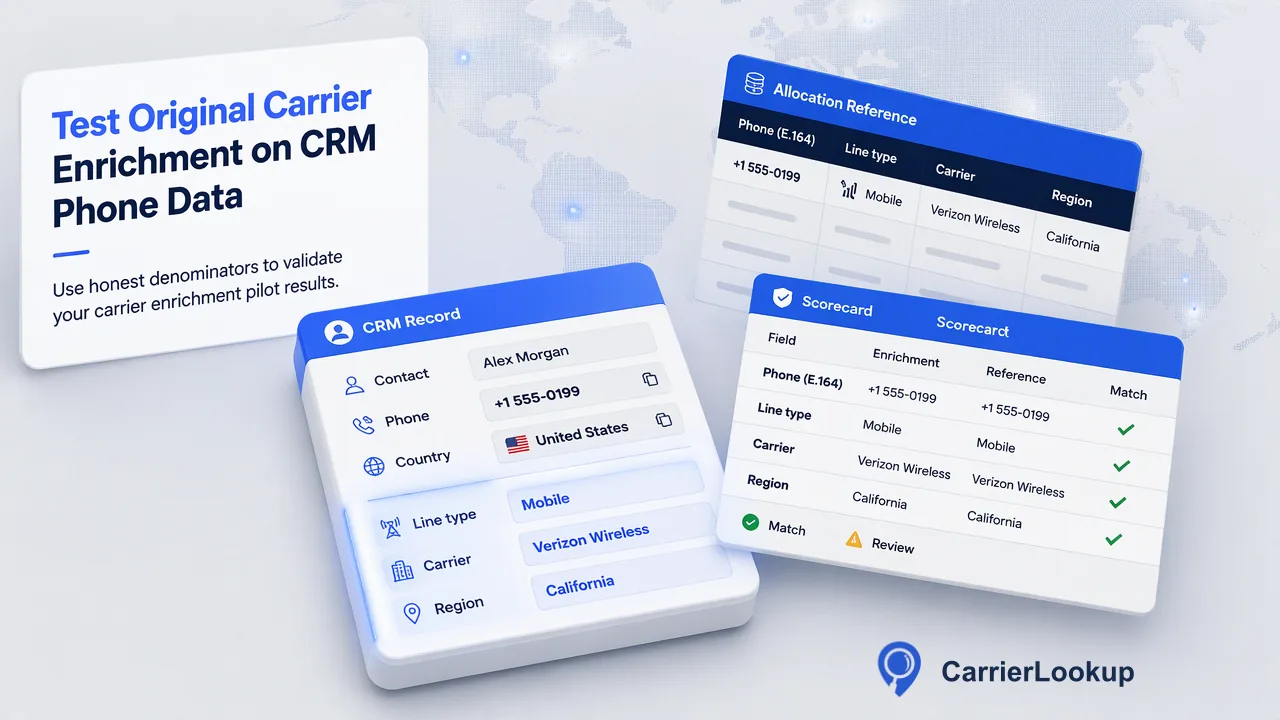
A carrier enrichment pilot should test the exact allocation fields and CRM decisions the team will use, with clear denominators for missing and conflicting data.
To evaluate carrier enrichment, sample authorized CRM phone records across the countries, formats and line types your team actually handles. Compare returned original-allocation fields with a suitable allocation reference, not a current-network observation. Count rejected inputs, completed records with empty fields, and conflicting references separately. Set acceptance criteria around the CRM action the data supports rather than a vendor-wide accuracy claim.
Choose the CRM decision and a representative sample
A CRM owner may want to add original carrier and line-type context to existing phone records before a data-cleaning project. The useful question is not whether an API reports a high global accuracy percentage. It is whether this team's own records gain fields that staff can interpret correctly and act on. Write the intended use first: display allocation context to an analyst, group records for manual review, or identify which input rows need formatting repair. Do not make a carrier field a proxy for deliverability, current network, ownership or consent.
CarrierLookup's original-carrier product reports the carrier to which a number range was originally allocated, with number type and allocation geography where available. It does not track the currently serving network after porting. For a small pilot, use the documented single or synchronous multi REST checks rather than preparing a production-sized file task. Select CRM rows you are authorized to process, preserving an internal row ID and the original phone value. Normalize a working copy to E.164 for the realtime API, and keep rejected or unparseable inputs in the pilot denominator.
Stratify the sample by the countries and record sources that matter to the business, by known format quality, and by expected mobile, fixed-line or other line-type cases where you have a defensible reference. Include older imports and recent records if those sources differ in quality. A random draw alone can hide a small but important country slice; a hand-picked set of easy numbers can make the pilot look better than the eventual workload. Report counts per slice and do not convert this sample into a claim about all countries.
Build an original-allocation reference before scoring
The reference must answer the same question as the product field. A current subscriber-network result, a recent call outcome or a sales rep's note does not establish the original carrier of a number block. For sampled numbers, seek the relevant numbering allocation records or another documented original-allocation source, and record its date and scope. When no trustworthy reference is available for a row, label it unverified rather than treating the provider as right or wrong. For region and city, compare number-allocation geography, not the contact's current location.
A reviewer should annotate which fields have an agreed reference: original carrier, underlying carrier where relevant, number type, country code, region and city. The API reference lists these as the carrier result fields; optional values can be empty. Save the source and review date for each reference, because allocation tables and a CRM's own metadata may use different names or levels of detail. Define a normalization rule for carrier names before computing matches. Otherwise, spelling differences or parent-brand aliases will be counted as incorrect data without a substantive disagreement.
If two credible sources conflict, keep the conflict as a separate review case. Do not silently select whichever label agrees with the vendor. Examine whether the sources describe different dates, original versus current network, or a host network versus a brand. A small pilot may reveal that the team's reference set needs work as much as the enrichment does. That is useful for an adoption decision, even if it prevents a simple accuracy percentage.
Use a field-level scorecard with honest denominators
For every input row, record formatting status, request status, completed lookup status, returned field values, reference availability and the reviewer decision. A rejected E.164 input is not a carrier miss. A transport timeout is not an empty completed result. A successful code-zero response with empty optional carrier fields is a completed lookup with unavailable values; it can still be charged. For synchronous multi checks, an item without a normal result should remain distinct from a valid negative interpretation.
| Measure | Denominator | Decision it informs |
|---|---|---|
| Input acceptance | All sampled authorized CRM rows | How much preparation the data needs |
| Completed lookup coverage | Accepted requests | How much of the sample produced normal results |
| Original-carrier agreement | Completed rows with a trusted original-allocation reference | Whether that field is dependable for this use |
| Field availability | Completed rows in each country or source slice | Whether analysts have usable context |
| Human review effort | Rows requiring interpretation or conflict resolution | Whether the workflow saves work |
Report raw counts beside percentages. An overall agreement rate should not combine rows with no reference, request failures and genuinely contradictory carrier labels. Break out missing carrier, missing number type and missing geography because they have different business consequences. The CRM enrichment testing comparison discusses sample coverage and correctness; this scorecard adds the essential original-allocation reference and field-level accounting for this particular service.
Choose acceptance criteria tied to the business action
Before seeing the scorecard, decide what is good enough for the proposed CRM use. If the data is only displayed as context, a team may tolerate missing optional fields as long as they are clearly marked unavailable. If a rule would automatically route records based on number type, examine disagreement and unknown rates for that exact field and require a human path for exceptions. Set thresholds from your workload and consequence of error, not from a generic benchmark. The B2B enrichment benchmark discussion likewise warns that segment and field differences sit behind broad claims; its figures are not CarrierLookup performance figures.
Consider a hypothetical pilot with several source systems. One source may have many badly formatted numbers, while another has clean E.164 entries but weak original-allocation references. Do not collapse the first into provider error or the second into proven accuracy. A useful result might be to clean input formats before buying more checks, or to use the returned carrier as review context while postponing automation. Record each decision and the remaining uncertainty. The pilot should also estimate the cost of completed checks from the current pricing terms, without assuming that empty optional fields are free.
If the sample supports the intended use, start with a limited workflow and compare later exceptions against the same reference rules. If it does not, change the field use or sample design before expanding. Open the CarrierLookup API documentation, choose a small authorized CRM sample and write the reference and action columns first; only then run the checks.
Learn More
Choose the product information that fits the next step in your workflow.