
US Phone Number Carrier Lookup: Original Carrier Data for +1 Numbers
Find original carrier, number type and allocation geography for US numbers while accounting for portability and list preparation.
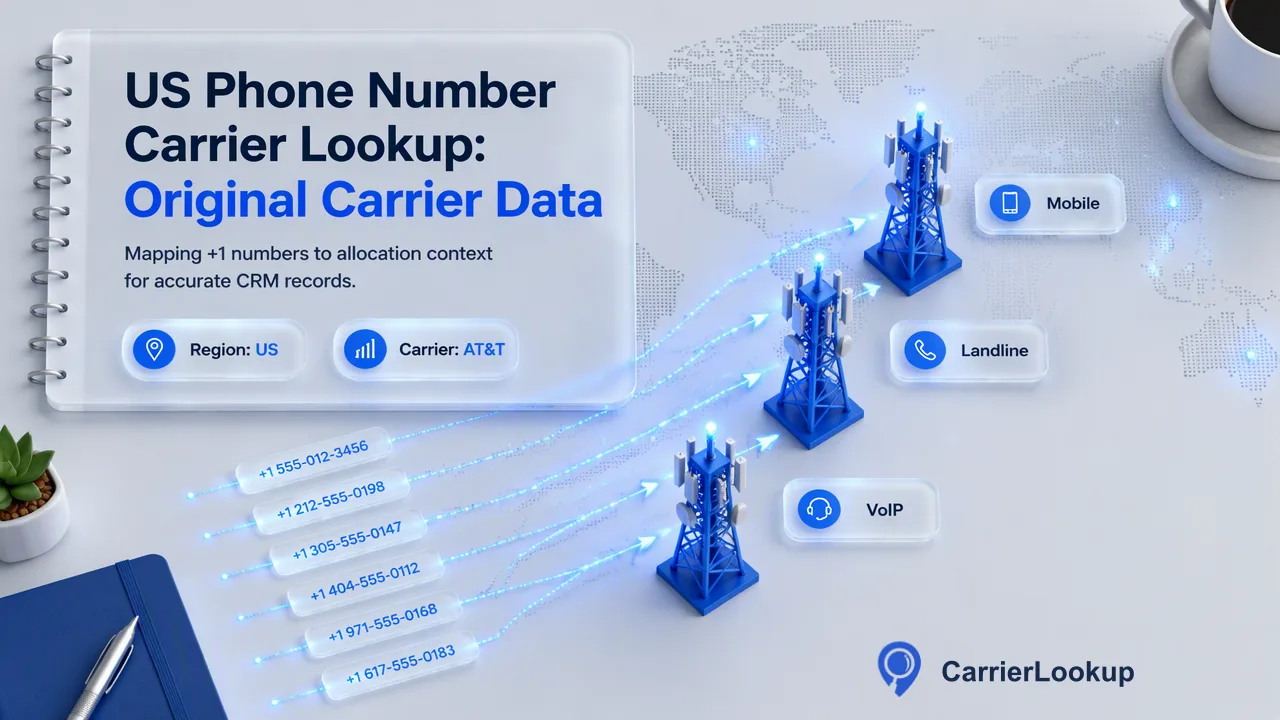
Find original carrier, number type and allocation geography for US numbers while accounting for portability and list preparation.
A US phone number carrier lookup can show the carrier to which a +1 number range was originally allocated, along with number type and allocation geography. It does not identify the operator serving a ported number today. For a few numbers, use a same-response lookup; for a prepared whole-country list, use a separate file task with the United States selected and review the returned values before adding them to a CRM.
Prepare a US +1 number for a single lookup
Start from a verified US source number. In E.164 form, the submitted value begins with +1 and continues with the national number, without spaces, parentheses or hyphens. Do not treat every +1 number as US by default: Canada and other North American Numbering Plan locations also use +1. The source record or other reliable country information should establish that the number belongs in a US list.
Keep the original value beside the normalized form. If the source is a spreadsheet, store the normalized field as text so that the plus sign and all digits survive export. A visual phone-number format in a cell may change only display. Check a sample in a plain-text export before sending a batch. Also separate an extension from the phone number; it is not part of the E.164 value submitted to a lookup.
CarrierLookup's realtime Original Carrier Lookup accepts one E.164 number through the dashboard or POST /api/v1/check. It returns a same-response result when decided. Begin with one known row to confirm that the team's normalization and field mapping work before processing the rest of a list.
Read carrier and area information as allocation context
The carrier result identifies the originally allocated carrier for that number range. Underlying carrier, number type, country code, region and city provide additional allocation context when available. The region or city is not the person's present location. An area code can be a useful clue about historical assignment, but it is not evidence that the contact lives there now.
The FCC explains number porting as keeping a number when changing providers. A ported US number can therefore have a different serving provider from the one named by original allocation data. A CRM field should say “original carrier,” not simply “carrier,” to keep that distinction visible to future users. If a team needs a different carrier concept, it should select a separately documented source for that question.
A code-zero completed lookup can have empty carrier fields. Keep the empty values as unavailable rather than filling in a carrier from an area-code table. If the input is rejected or the check is undecided, hold that row separately. This keeps a normal-but-empty result distinct from a request that did not produce a completed lookup.
Use the pasted batch for a short US list
When an operator has several records to check, CarrierLookup offers a dashboard realtime batch for up to 500 pasted numbers. Its REST synchronous multi endpoint accepts up to 100 E.164 numbers and returns ordered results in the same request session. The REST multi route can include numbers from different countries, but each input should still be mapped to its own source record and known country.
Keep an input index or stable CRM key beside each submitted number. On return, attach the ordered result to the matching record and record the lookup date. In a synchronous multi result, exists=false means the row has no normal result; it does not prove that the number is invalid or disconnected. If the whole multi request times out, the documented behavior is a whole-request failure rather than partial results. Review the request outcome before writing enrichment values.
A short-list batch can answer allocation questions efficiently, but it should not overwrite separate fields for permission, owner or service status. Those fields have different sources. A team can use number type to prioritize manual review of mobile versus landline records without assuming a message will be delivered.
Prepare a larger US-only file task
For a large backlog, CarrierLookup has an asynchronous Global carrier lookup file workflow. Prepare a one-column TXT or CSV with one country-coded number per line and select the United States at submission. The list should be essentially from the selected country. Because +1 is shared, do not infer US membership from the country code alone; use the CRM's trusted country data to separate US and non-US records before creating the file.
The file task moves through processing, success or failed states. Poll according to the documented interval, then download the single result CSV after success. Its identifier is plain digits with country code, without a plus sign or spaces. Build a reversible join between that value and the CRM's +1 E.164 field, and keep a record of rows excluded during preprocessing. Empty fields in the result CSV are unavailable values, not negative facts.
Check the current CarrierLookup API reference for the live file limits and acceptance rules. Avoid turning the file task into a pretend same-response API call. Its upload, processing and result-download stages need separate monitoring and an owner who checks the completed file before import.
Put the result to work without overclaiming
The useful CRM fields are the checked number, date, original carrier, number type and allocation geography. Add the underlying carrier only when the returned value is available and relevant to the team's grouping. For a sales-ops list, this can support a review queue for mismatched source labels or a segmentation exercise by allocation category. It cannot establish who controls a contact number, whether the line is in service or whether the person agreed to outreach.
Sample the imported results. Compare original numbers with normalized inputs, inspect records from more than one area code, and verify that empty fields stayed empty. Review any US/Canada ambiguity in +1 source data. If a later record is corrected, run a fresh lookup for the corrected number and retain the earlier check as historical data. The lookup is most useful when its original-allocation meaning remains clear from acquisition through CRM use.
FAQ
Does a US carrier lookup show the operator serving a ported number?
CarrierLookup reports original number-range allocation. A number retained through a provider change can have a different serving operator, so label the CRM field as original carrier.
Can every +1 number go in a United States file task?
No. The +1 code is shared. Use trusted source-country data to prepare a list that is essentially from the selected United States country group.
How should teams treat an empty carrier field?
Keep it as unavailable with the lookup date. An empty value in a completed lookup is not proof that a number has no service or belongs to no provider.
Learn More
Choose the product information that fits the next step in your workflow.