
Single vs Bulk Carrier Lookup: Architecture and Workflow Guide
Compare realtime synchronous carrier lookups with asynchronous bulk file processing to select the right phone data integration for your workflow.
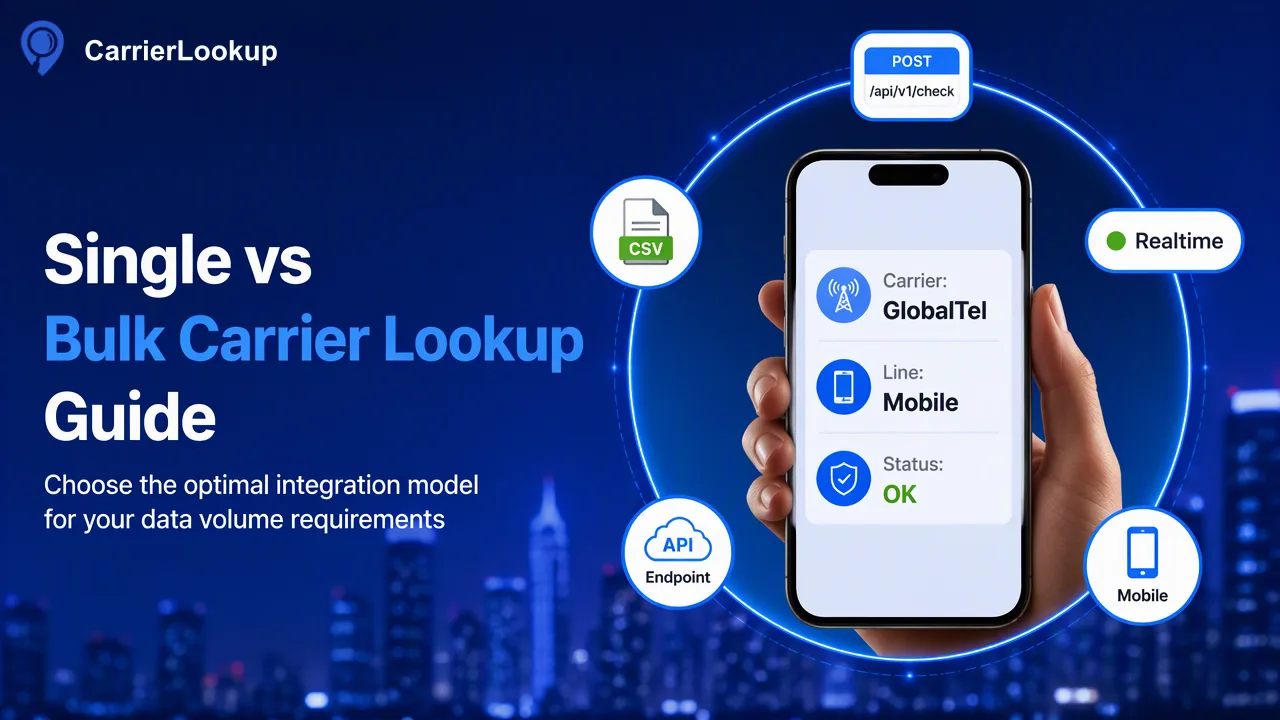
Compare realtime synchronous carrier lookups with asynchronous bulk file processing to choose the right integration model for your data volume and latency requirements.
Choosing between single and bulk carrier lookup depends primarily on workflow latency requirements and dataset volume. Realtime synchronous lookups evaluate individual numbers or small multi-number batches immediately, making them suitable for active user touchpoints such as account registration or instant risk assessment. In contrast, asynchronous bulk lookups process large phone lists submitted as files in the background, returning complete results in a single downloadable file. Both service models report original carrier allocation, line type, and allocation geography, rather than current network status after porting or active device connectivity.
Realtime Synchronous Lookups for Interactive Touchpoints
The Original Carrier Lookup API is engineered for applications requiring immediate data availability during active user sessions.
Synchronous execution operates through two primary endpoints. Individual checks use POST /api/v1/check to inspect a single E.164 formatted number, delivering allocation data directly in the immediate response. For small batches, POST /api/v1/batch-check accepts between 1 and 100 numbers in input order, while the web dashboard accommodates up to 500 numbers in an interactive run.
In synchronous multi-number requests, each item indicates whether a normal result exists rather than communicating device connectivity or line disconnection. Realtime describes the synchronous request-response cycle rather than live network telemetry. This model works best when user onboarding or transaction screening requires immediate original allocation context before proceeding.
Asynchronous Bulk File Processing for Large Datasets
When organizations manage large historical databases or scheduled audit files, synchronous connections can tie up application threads. The Global carrier lookup service handles high-volume tasks through an asynchronous file workflow.
Teams submit one-column TXT or CSV files containing phone numbers formatted with their country code using POST /api/v1/bulk-tasks. Bulk files focus on a single selected country, and per-product limits apply regarding batch capacity and file size. Automated preprocessing inspects the file, excluding duplicates, malformed entries, and numbers outside the designated country.
Once submitted, the task enters background processing. Systems query task status using GET /api/v1/bulk-tasks/{id} at recommended intervals of at least 30 seconds. Upon successful completion, the service provides a single downloadable CSV file containing allocation fields for all completed rows.
Technical Comparison: Input, Latency, and Delivery
Evaluating single versus bulk processing requires aligning operational requirements with service design:
| Operational Dimension | Realtime Synchronous Lookup | Asynchronous Bulk File Processing |
|---|---|---|
| Primary Interface | Web dashboard, REST API, or MCP integration | Web dashboard or REST API file submission |
| Input Format | Single number or list up to 100 via API (500 on dashboard) | One-column TXT or CSV file |
| Country Scope | Accepts mixed country codes in a single request | Requires a single designated country per file |
| Response Timing | Immediate synchronous response | Asynchronous background execution |
| Result Retrieval | Inline structured payload | Status polling and single CSV file download |
| Retrieval Endpoint | Same HTTP connection | GET /api/v1/bulk-tasks/{id} |
For real-time automation within agentic or AI-assisted systems, teams can also Read the CarrierLookup MCP docs to implement synchronous checks, whereas bulk file tasks are exclusively managed via the dashboard and REST API.
Decision Framework: Selecting the Optimal Integration Model
Selecting between realtime and bulk workflows centers on data ingestion patterns, latency tolerance, and architectural overhead.
When to Select Realtime Lookups
Synchronous requests are optimal when downstream logic depends on instant data. Examples include:
- Validating input formatting and original assignment during account creation.
- Feeding allocation context into instant fraud screening pipelines.
- Querying records on demand through conversational interfaces using MCP tools.
When to Select Bulk File Processing
Asynchronous tasks are preferable when processing large volumes where immediate responses are unnecessary. Examples include:
- Enriching existing contact records during periodic database hygiene initiatives.
- Preprocessing historical directories prior to CRM migrations.
- Conducting offline telephony dataset analysis across a specific national numbering plan.
Critical Allocation Boundaries
Regardless of delivery method, both models report original number assignment rather than current carrier data after porting. As noted by the FCC on phone porting, subscribers frequently retain numbers when switching networks. Consequently, allocation records must serve as institutional context rather than active routing instructions or identity verification.
FAQ
Does carrier lookup reveal the current network provider after porting?
Carrier lookup returns the carrier to which the number range was originally assigned, not the current serving network after a subscriber ports their number. In telecommunications environments where number portability is standard, original allocation context provides structural insight into number assignment rather than live routing information, subscriber identity, active line state, or message delivery guarantees.
Can organizations use bulk file processing for interactive user workflows?
Bulk processing is designed for asynchronous operations and is not suited for interactive, latency-sensitive user touchpoints. Because bulk file jobs require file preprocessing, background execution, and periodic status polling, teams should route real-time registration or instant decision workflows through synchronous single or multi-number endpoints instead.
What allocation data fields are returned across both service models?
Both synchronous checks and bulk file processing supply original carrier assignment, underlying carrier details, line classification, country code, region, and city allocation. These attributes reflect administrative numbering-plan allocation geography rather than the physical, real-time location of a handset or subscriber.
Learn More
Choose the product information that fits the next step in your workflow.