
Russia Phone Number Carrier Lookup for +7 Lists
Learn russia phone number carrier lookup with correct number formatting, original allocation context, and practical single or list-check workflows.
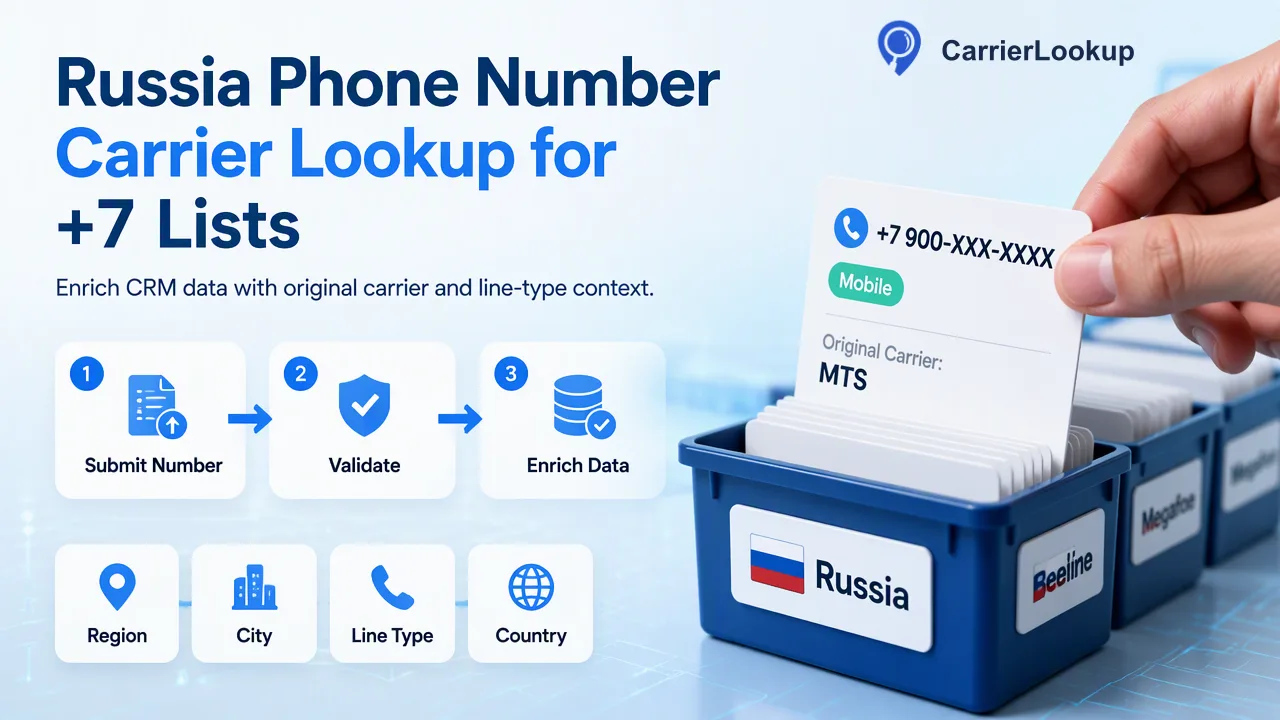
A practical guide to russia phone number carrier lookup for contact-data teams.
A Russia phone number carrier lookup can report the operator to which a +7 number range was originally allocated, plus available line-type and allocation-region context. It cannot tell which operator currently serves a ported number or where its user is now. For a few numbers, use a synchronous lookup; for a prepared Russian list, use a country-selected file task. Check country assignment carefully because Russia and Kazakhstan share +7.
Start with the meaning of a +7 number
A +7 prefix alone does not settle whether a record belongs in a Russian or Kazakh list. The ITU operational bulletin on the +7 numbering zone describes the joint use of that code by the Russian Federation and Kazakhstan and allocates ranges between them. A CRM team should use reliable source information and the applicable numbering assignment rather than labeling every +7 contact Russian. This matters most when preparing a file task that asks the team to select one country.
Normalize the number to E.164 form for realtime checks: leading plus sign, country code, then subscriber number, without spaces or separators. Keep the original source value separately so that a correction can be traced. A rejected format is an input problem, not a finding that the number has no carrier. If a record cannot be confidently assigned to the intended country, hold it for review before building the Russian file.
The relevant output is original number-allocation context. The carrier field names the operator to which the range was originally assigned. It is not a live query of the number's current network. A ported number may now be served by a different operator. The team should label the CRM field “originally allocated carrier” rather than simply “current carrier” to avoid misleading downstream users.
Choose a synchronous lookup for a few records
CarrierLookup's Original Carrier Lookup has a single-number API check and a synchronous multi-number API check. POST /api/v1/check accepts one E.164 number. POST /api/v1/batch-check accepts 1–100 numbers and returns ordered results in the same request flow; the numbers can come from different countries. The dashboard realtime batch supports a separate limit for pasted numbers. The API documentation is the reference for exact requests and result handling.
A synchronous result can include carrier, underlying carrier, number type, country code, region, and city. Optional fields may be empty. A completed lookup with empty carrier fields still represents a completed lookup, so do not automatically reclassify it as a request failure. In a multi response, exists=false means no normal result for that item; it is not proof that the number is disconnected or invalid. Preserve each result's place against the submitted input order and investigate exceptions separately.
This path works when an operator is correcting a small set of CRM rows or a developer is enriching a newly submitted number. The term “realtime” describes the response workflow, not a live network status or a guarantee that a device is reachable. Keep the selected service and check date with the result so analysts know what the field represents.
Prepare a Russian file task for a whole list
For a large, prepared list, the separate Global carrier lookup is an asynchronous file task. Its input is a one-column TXT or CSV file with one country-coded number per line and one selected ISO country. A Russian task should contain records that belong to Russia, not a mixture of every +7 number in a regional CRM. Bulk preprocessing excludes invalid, duplicate, uncoded, and out-of-country rows. The API documentation gives current entry and file-size limits, which should be checked before submission.
A file task moves through processing, success, or failed. Poll no more often than once every 30 seconds. After success, download one CSV; it is not a ZIP or a per-number live stream. The bulk identifier is plain digits with country code and no leading plus sign, so a CRM join should account for that documented representation. Keep stable source IDs in the team's own mapping, compare the prepared input to the completed output, and hold unmatched rows for review.
A task can fail during preparation if acceptance conditions are not met. Do not interpret that failure as a “no carrier” result for every submitted number. Inspect the cause, correct the file, and decide whether a new task is appropriate. The initial balance reservation is reconciled at completion; that accounting event should not be confused with whether a particular row produced carrier data.
Read Russian allocation fields without overclaiming
The region and city fields refer to allocation geography for a number range. They do not describe a person's current residence, device location, or travel. A team can use them to group records by documented allocation context, but should not geolocate an individual from these fields. The underlying-carrier field may add another allocation-related name; do not treat it as a current serving-network result unless the product documentation says so, which the current profile does not.
For CRM cleanup, keep “country assignment reviewed,” “original carrier,” “number type,” and “allocation region” as separate concepts. A record with an unexpected region may deserve a source-data review, but the lookup alone cannot establish an incorrect address or ownership. If a Russian +7 entry may belong to Kazakhstan, send it back through the country-assignment step rather than forcing it into a Russian segment.
The central benefit is a cleanly labeled context field. Teams can compare allocation information with their own contact data without pretending the lookup answers delivery, activity, messaging-app registration, identity, or consent. The original-allocation meaning should appear in the report title as well as the data dictionary.
FAQ
Does +7 always mean a Russian number?
No. Russia and Kazakhstan share the +7 numbering zone, so country assignment needs more than the prefix alone.
Can the lookup show the current operator after portability?
No. The carrier field is the operator to which the number range was originally allocated.
What does region mean in the result?
It is number-range allocation geography, not the current location of the person or device.
When should a team use a file task?
Use the asynchronous country-selected task for a prepared large list, then review the downloaded CSV after success.
Learn More
Choose the product information that fits the next step in your workflow.