
Product guidance
Why Static Carrier Data Fails: The Necessity of Real-Time Portability Lookups
Discover why static databases fail due to number portability and how real-time carrier lookup provides essential allocation context for business workflows.
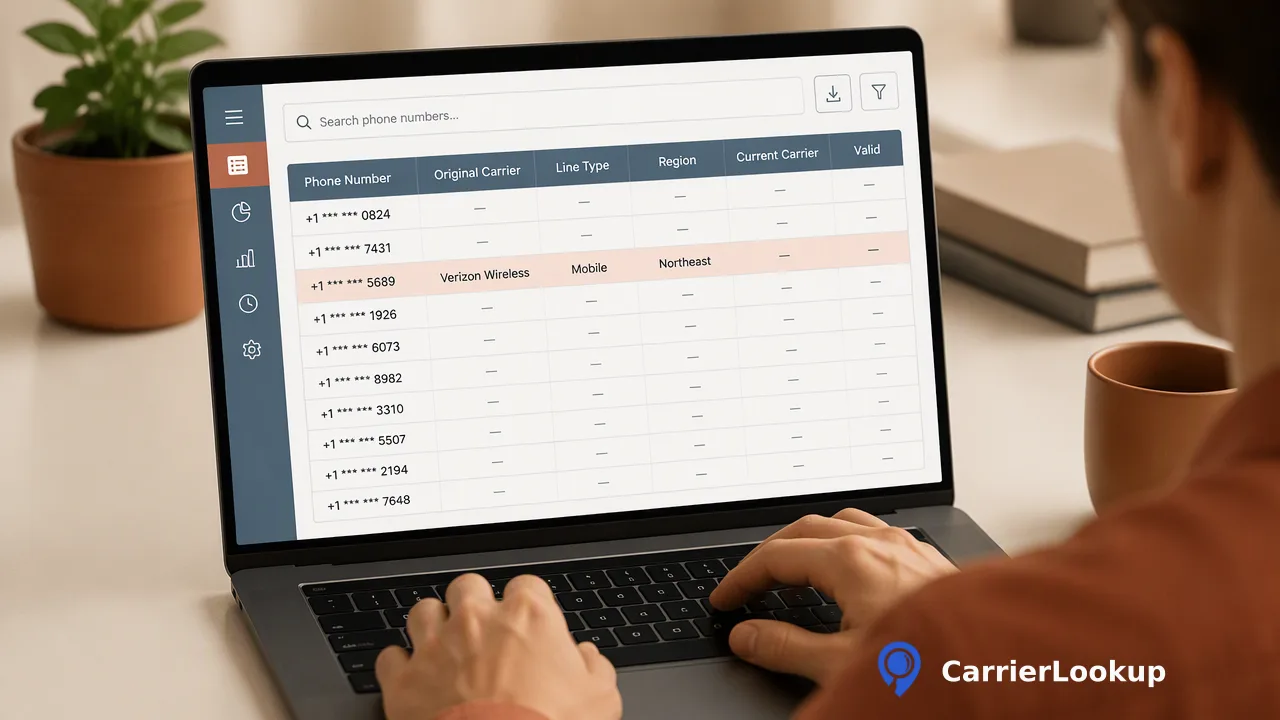
Explore why static phone number databases fail to account for number portability and how real-time carrier lookups provide essential allocation context for business workflows.
Static phone number databases rely on original allocation records, which become inaccurate as users port numbers between carriers. Because static tables cannot track these changes, they fail to provide the current network context required for accurate routing and segmentation. Real-time carrier lookup provides the necessary allocation metadata—including the original assigned carrier, line type, and allocation geography—to inform business operations without relying on outdated prefix-based assumptions. By integrating a real-time carrier lookup through a REST API or web dashboard, organizations can retrieve this allocation context to support manual review prioritization and data hygiene workflows. This approach ensures teams organize records using accurate structural data rather than obsolete prefix logic.
The Limitations of Static Carrier Databases
Historically, organizations relied on static databases and prefix-based routing logic to determine the network associated with a phone number. This method assumes that a specific block of numbers permanently belongs to the network that originally issued it. However, number portability allows subscribers to move their phone numbers from one carrier to another while retaining the exact same digits. This capability renders static, prefix-based routing tables obsolete. When a user ports their number, the original allocation data remains unchanged in static tables, leading to inaccurate network identification. Static databases only track the original allocation and cannot account for these subsequent network changes. Consequently, systems relying solely on static prefix logic will miscategorize ported numbers, disrupting segmentation and review workflows. To maintain accurate structural data, organizations require tools that query allocation context dynamically rather than depending on hardcoded prefix assumptions that fail to reflect the reality of number portability.
Original Allocation vs. Current Network
Understanding the distinction between original allocation and the current serving network is critical for evaluating phone number data. Original allocation describes the specific network to which a phone number range was first assigned by telecommunications authorities. In contrast, the current network is the carrier actively serving the subscriber after any number portability events have occurred. CarrierLookup provides the original assigned carrier, not the current network after number portability. When teams perform a real-time carrier lookup, the system returns this foundational allocation context. It is important to recognize that this data reflects the structural assignment of the number rather than its real-time routing destination. By retrieving the original assigned carrier, organizations gain valuable metadata about the number's origin. This distinction ensures that teams correctly interpret the returned carrier and line-type signals as allocation context, rather than mistakenly treating them as proof of the current serving network or active reachability.
Operationalizing Carrier Allocation Data
Organizations can operationalize carrier allocation data to support segmentation and prioritize manual review queues within their customer relationship management (CRM) systems. A real-time carrier lookup provides essential metadata, including the carrier, line type, and allocation geography. For example, synchronous results from the POST /api/v1/check endpoint can include carrier, number_type, country_code, region, and city fields. Teams can use this line-type and carrier data to organize records and inform internal decisions. The region and city fields describe the number-allocation geography, providing structural context for segmentation. It is crucial to note that this allocation geography represents the area where the number block was issued, not a person or device's current physical location. By integrating these signals into their workflows, organizations can systematically categorize phone numbers based on their original assignment, helping teams review and process records more efficiently without overestimating the data's scope.
Best Practices for Data Hygiene
Maintaining clean CRM records requires integrating carrier allocation data thoughtfully. Organizations should store normalized carrier and line-type metadata to support data hygiene without treating the results as proof of active service. When processing numbers, teams must interpret API responses correctly. A result of registered=true means allocation data was found. Conversely, registered=false is a normal no-allocation-data result, not proof of a disconnected or nonexistent number. Similarly, in synchronous multi-number checks, exists=false simply indicates a lack of allocation data rather than a negative carrier conclusion. For large-scale hygiene tasks, organizations can use asynchronous bulk processing to handle 1,000 to 100,000 valid numbers from a single country, ensuring that CRM databases remain updated with accurate original allocation metadata.
Technical Workflows for Carrier Lookup Integration
Integrating real-time carrier lookup capabilities into existing systems requires selecting the appropriate technical workflow based on volume and latency requirements. CarrierLookup supports phone-number workflows through a web dashboard, REST API, and Model Context Protocol (MCP). For immediate, low-volume needs, the POST /api/v1/check endpoint performs a single check using an API key. When teams need to process small batches quickly, the POST /api/v1/batch-check endpoint handles 1 to 100 identifiers synchronously in input order. For larger data hygiene operations, bulk carrier tasks utilize the carrier_batch service type. This asynchronous bulk processing method supports lists of 1,000 to 100,000 valid numbers from a single country, providing a downloadable result file upon completion. In all synchronous responses, unavailable fields are returned as empty strings. By aligning the chosen endpoint and processing method with operational demands, organizations can efficiently retrieve carrier, line-type, and allocation geography signals to inform their internal systems.
FAQ
Why is static carrier data often inaccurate?
Static carrier data relies on the original allocation of phone number blocks and utilizes prefix-based routing logic. Because number portability allows subscribers to switch carriers while keeping their exact phone numbers, static databases quickly become outdated. They cannot track these network changes, meaning they frequently misidentify the carrier for ported numbers and fail to provide accurate structural context for modern workflows.
Does a carrier lookup confirm if a number is currently active?
It strictly provides the original assigned carrier alongside available line-type and allocation geography fields. Furthermore, a result of registered=false or exists=false is simply a normal indication that no allocation data was found; it does not mean the phone number is disconnected, nonexistent, or invalid.
How should organizations use carrier allocation data in their CRM?
Organizations can use carrier allocation data to organize records and support manual review prioritization within their CRM. By storing the original assigned carrier, line type, and allocation geography, teams gain structural context for segmentation. This metadata helps inform internal decisions and data hygiene workflows, provided teams understand that the geography reflects the number's issuance region rather than a person's current physical location.
What fields are returned in a synchronous carrier lookup?
Synchronous results from a real-time carrier lookup can include the carrier, number_type, country_code, region, and city allocation fields. These fields provide the original assigned carrier and allocation geography context to inform business operations. If specific allocation data is unavailable for a given phone number, those fields are simply returned as empty strings. This structured metadata supports internal segmentation and review workflows.