
Product guidance
Beyond Regex: Why Python Developers Need Real-Time Carrier Data for Phone Validation
Learn why python phone number validation requires more than regex. Combine E.164 normalization and carrier allocation data to optimize backend workflows.
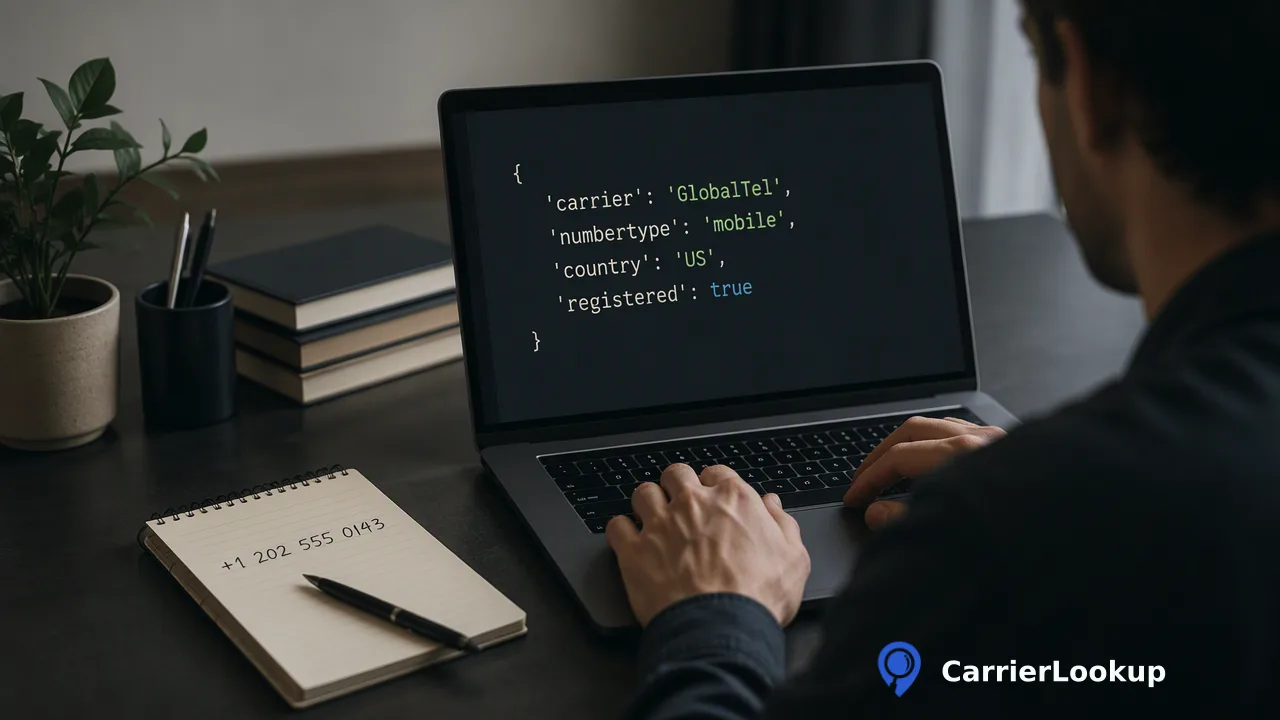
Discover why python phone number validation requires more than regular expressions. Learn how metadata parsing, E.164 normalization, and carrier allocation signals support robust data pipelines.
While regular expressions can confirm basic string structure, effective python phone number validation requires metadata-aware parsing and carrier allocation lookups. Regular expressions quickly fail when handling complex international numbering plans, evolving area codes, and variable subscriber lengths across jurisdictions. In contrast, metadata libraries parse and normalize phone strings into standard E.164 formats, determining whether an input represents a possible number. Furthermore, carrier allocation lookups provide operational context regarding assigned network operators, line types, and allocation geography. Integrating these distinct layers supports data hygiene, informs routing rules, and enriches CRM workflows without relying on brittle, hard-coded pattern matching.
The Limitations of Regex in Phone Validation
Many developers initially approach python phone number validation with regular expressions. While regex performs fast preliminary pattern filtering, it struggles with the sheer complexity of global telecommunication standards. National numbering plans change frequently as regulatory bodies adjust area codes, extend subscriber ranges, and allocate new numbering blocks. A simple regex pattern often rejects valid international numbers or accepts syntactically plausible strings that do not correspond to any valid numbering authority. Furthermore, regular expressions operate purely on textual patterns without structural context. They cannot determine whether a country code actually exists, whether national destination codes are valid, or how numbering ranges are organized. Attempting to build and maintain comprehensive regex patterns across multiple countries leads to fragile codebases that produce false rejections and degrade user onboarding workflows.
Moving to Metadata-Aware Parsing and E.164 Normalization
To overcome the limitations of regex, Python workflows benefit from metadata-aware parsing tools such as Google's libphonenumber library or its Python ports. These libraries maintain structured tables of international numbering plans, allowing systems to evaluate whether a supplied string represents a possible or valid number within a specific country. A critical responsibility of metadata-aware parsing is standardizing records into the E.164 format. E.164 formatting combines the country calling code, national destination code, and subscriber number into a single, unified string prefixed with a plus sign, without punctuation or spaces. Enforcing E.164 normalization across database schemas eliminates formatting discrepancies caused by local dialing prefixes or differing user inputs. This structural consistency ensures clean indexing across storage layers and establishes reliable inputs for downstream communication and verification pipelines.
The Role of Carrier Allocation and Line-Type Data
Format validation confirms that a number follows legitimate conventions, but it cannot reveal how telecommunication authorities have allocated the number. Carrier allocation data adds vital operational context by providing details about the assigned telecommunications provider, number type, and administrative territory. Line-type categorization allows systems to distinguish between mobile, fixed-line, and other number types. Crucially, carrier allocation describes the originally assigned network, not the current carrier after porting. Rather than establishing reachability, these attributes inform internal categorization, support fraud review teams, and help maintain high-quality customer records by flagging incongruous line configurations before dispatching downstream tasks.
Integrating Carrier Context into Python Pipelines
Developers can integrate carrier lookup services into Python data pipelines using REST API requests or automated batch workflows. CarrierLookup offers synchronous lookups via POST /api/v1/check for individual records and POST /api/v1/batch-check for processing 1 to 100 identifiers synchronously in input order. Asynchronous processing through service type carrier_batch is also available for bulk tasks containing 1,000 to 100,000 numbers from a single country. Synchronous responses supply available attributes, including carrier, number_type, country_code, region, and city. In these responses, registered=true indicates that allocation data was successfully found, whereas registered=false is a standard result reflecting an absence of allocation records rather than a disconnected line. Developers should remember that region and city fields describe number-allocation geography rather than a person or device's current location, providing administrative context that enriches customer records safely.
FAQ
Why is regex insufficient for global phone number validation?
Regular expressions only evaluate whether a string matches a predefined pattern. They do not account for the diverse rules governing international numbering plans, valid country calling codes, or regional length exceptions. Maintaining regular expressions for hundreds of jurisdictions is fragile and labor-intensive.
What is the difference between format validation and carrier lookup?
Format validation inspects the numerical structure of a string to verify that it conforms to standard numbering rules and normalizes it to E.164 formatting. Carrier lookup goes beyond syntax by querying allocation records. This query returns operational attributes such as the carrier name, number type, and allocation region, providing contextual metadata to support downstream segmentation and data management workflows.
Does carrier allocation data indicate live subscriber status or current location?
No. Carrier allocation data provides the network and region to which a number block was assigned. Furthermore, region and city fields describe number-allocation geography rather than a person or device's current location, serving as administrative context rather than a live tracking mechanism.
Learn More
Choose the product information that fits the next step in your workflow.