
Product guidance
Why Regex Fails for Phone Validation: The Case for Carrier-Level Verification
Discover why regex syntax checks fail to ensure phone number validation reliability and how carrier allocation metadata strengthens enterprise data hygiene.
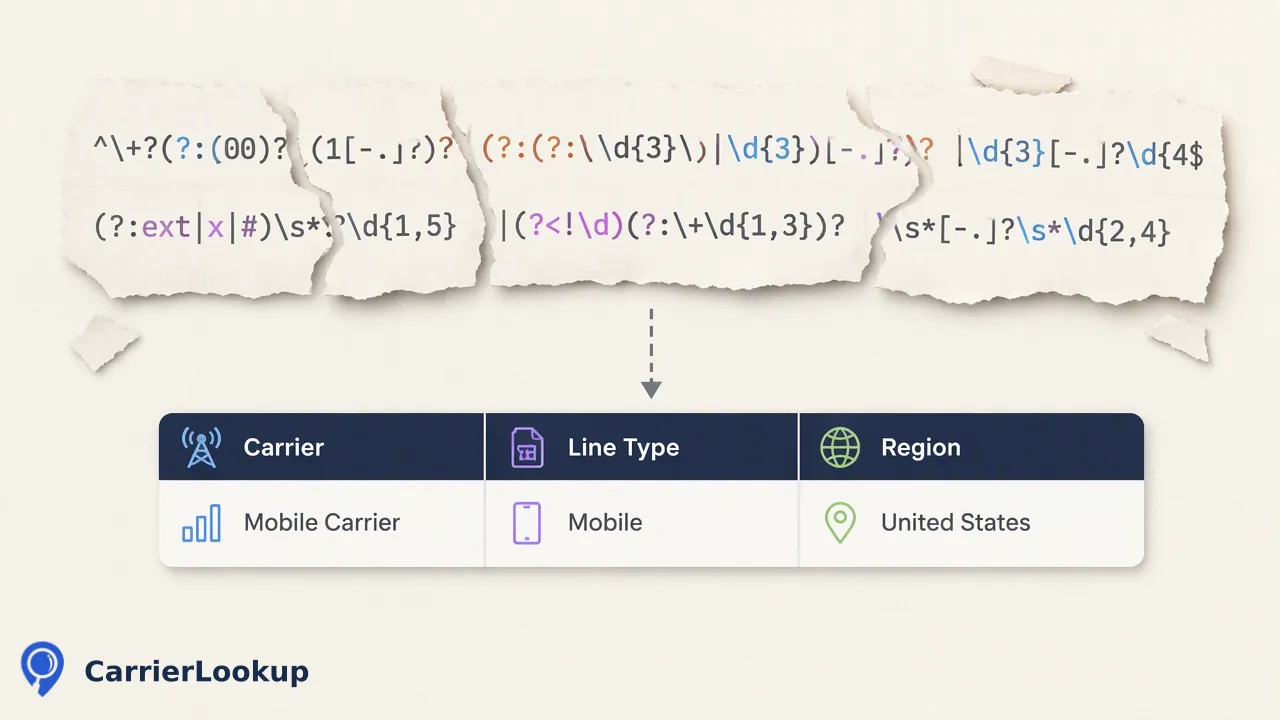
Understand the structural limitations of regular expressions for phone number validation reliability and how carrier allocation metadata improves data hygiene.
Relying on regular expressions for phone number validation reliability presents structural limits because syntax patterns only verify string formatting, leaving assignment and network context unexamined. Static expressions test whether a sequence of digits matches expected character lengths and country prefixes, but syntax checks cannot determine whether a number was actually allocated by a telecommunications authority. Because numbering plans evolve and area codes change, maintaining custom pattern tables creates continuous technical overhead. Grounding contact records in original carrier allocation metadata gives organizations verifiable telecom context, helping teams separate structured strings from assigned telecom blocks to improve data hygiene across business workflows.
The Inherent Limitations of Syntax-Based String Validation
Engineering teams routinely rely on regular expressions at data entry boundaries to verify user inputs. In telecommunications workflows, this approach creates an illusion of data integrity. A regular expression verifies only string syntax, checking whether an input string conforms to predetermined sequences of digits, spaces, and punctuation.
While regex effectively catches typographical mistakes such as missing digits or accidental letters, it treats every syntactically valid string as legitimate. A sequence such as +1 (555) 019-2834 easily satisfies common North American expressions despite belonging to non-working exchange blocks reserved for fictional use. Syntax validation operates entirely in a vacuum, decoupled from regulatory allocation databases and carrier routing registries. Consequently, pipelines using regex alone admit fabricated numbers into customer relationship management platforms and operational systems.
Telephony Plan Volatility and the Cost of Pattern Maintenance
Telecommunications numbering plans remain dynamic regulatory systems. Under the North American Numbering Plan and international telecommunications frameworks, administrative bodies regularly introduce new area codes, split regional splits, and adjust exchange allocations to accommodate population shifts.
Maintaining static expressions against this evolving landscape imposes persistent engineering maintenance. A pattern crafted to validate mobile ranges in a specific country quickly grows stale when regulatory authorities activate fresh prefixes. If an engineering team maintains overly strict regular expressions, legitimate incoming records face false rejections at intake forms. Conversely, relaxing patterns to accept broad digit lengths invites widespread invalid data. Because international numbering plans defined by ITU-T Recommendation E.164 permit varied national significant numbers up to fifteen digits, pure syntax rules fail to balance precision with coverage.
Carrier Allocation Metadata as a Structural Foundation
Moving past syntax matching requires anchoring records in authoritative network assignment data. CarrierLookup provides original carrier and number-allocation context through REST API endpoints and batch workflows, returning structural telecommunications signals for incoming identifiers.
When evaluating phone number validation reliability, carrier-level intelligence exposes key structural parameters that syntax cannot surface:
- Originally Allocated Carrier: Identifies the network operator assigned the block, confirming that the prefix belongs to an established telecommunications carrier.
- Line Type Classification: Distinguishes mobile allocations from fixed-line or alternative ranges, supporting channel-specific routing.
- Allocation Geography: Discloses region and city allocation context, reflecting where the number block was registered rather than live device positioning.
CarrierLookup returns the network to which the numbering block was originally allocated, rather than post-porting carrier adjustments. This baseline telecom profile confirms that an identifier originates from a recognized telecommunications block.
Enhancing Enterprise Data Hygiene and Routing Workflows
Incorporating carrier allocation signals into enterprise systems transforms raw contact lists into structured operational assets. Instead of treating every ten-digit string uniformly, systems can partition records based on line type attributes and regional allocation context.
Practical Implementation Approaches
- Intake Normalization: Standardize incoming numbers into clean international format before evaluation.
- Synchronous Verification: Use
POST /api/v1/checkto retrieve original carrier, number type, and allocation geography at registration. - Channel Segmentation: Route landline allocations to voice-based contact centers while directing mobile allocations toward messaging queues.
- Database Cleansing: Process legacy contact stores asynchronously to identify records tied to unallocated ranges.
Aligning data collection with allocation signals also supports data minimization standards outlined in GDPR Article 5, ensuring organizations retain clean, structurally verified contact attributes suitable for internal reporting.
FAQ
Why is regular expression matching insufficient for phone number validation?
Regular expressions assess string structure rather than operational telecommunications data. A sequence of ten digits might satisfy a pattern perfectly while representing an unallocated area code or an unassigned exchange block. Because pattern matching evaluates text shapes in isolation, relying on it causes systems to store structurally plausible junk data that downstream communication systems fail to process.
What distinguishes syntax formatting from carrier allocation context?
Syntax formatting normalizes strings to international standards like ITU-T Recommendation E.164, verifying country prefixes and overall length limits. In contrast, carrier allocation reveals the telecommunications network that originally received that specific number block from regional authorities. This telecommunications metadata provides verifiable operational context, identifying whether the identifier stems from mobile, fixed-line, or voice-over-IP allocations.
Does a carrier lookup confirm whether a phone number is currently active?
A carrier lookup returns the network to which a numbering block was initially assigned and its allocation geography. It provides structural telecommunications context rather than real-time network presence, subscriber status, or reachability. Organizations use this allocation baseline to classify line types and organize contact databases alongside other identity and verification layers.
Learn More
Choose the product information that fits the next step in your workflow.