
Product guidance
Beyond Regex: Why Production Apps Need Metadata-Aware Phone Validation
Learn phone number validation best practices, moving beyond regex to metadata-aware parsing, canonical E.164 normalization, and carrier allocation context.
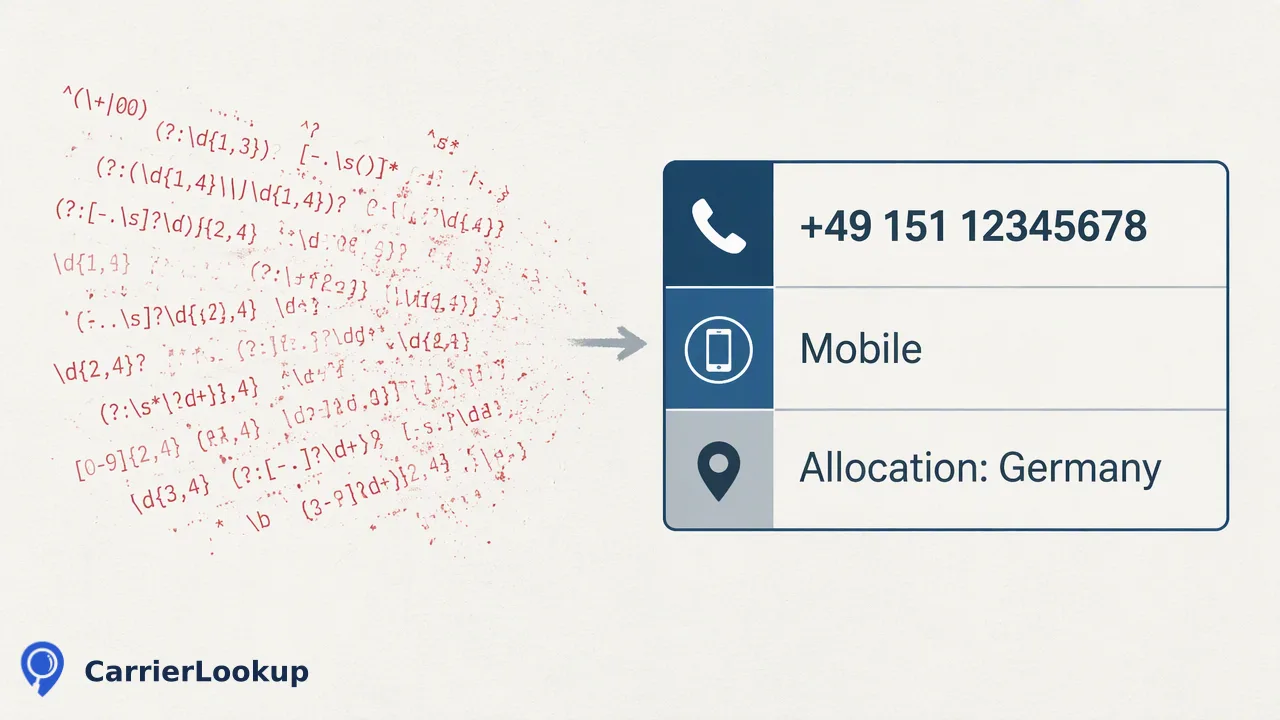
Relying on regular expressions for phone number validation leads to data errors. Discover why production workflows need metadata-aware validation, canonical E.164 normalization, and carrier allocation context.
Simple regular expressions are insufficient for production applications because string pattern matching cannot account for the complexity of global numbering plans or distinguish between different line types. Production systems require metadata-aware validation that checks inputs against regional numbering rules and normalizes them into canonical formats such as E.164. To properly support downstream operations, teams supplement structural validation with carrier-level allocation data. This metadata provides line-type, carrier, and geographic allocation context that helps teams inform routing, support CRM hygiene, and prioritize review queues without mistaking allocation records for real-time reachability or device tracking.
The Limitations of Regex in Production Systems
Many applications begin with client-side regular expressions to catch basic formatting mistakes in form inputs. While regex is useful for immediate user interface feedback, relying on pattern matching alone in production environments introduces significant data integrity risks. Regex models cannot account for the structural complexity of global numbering plans, where country codes, national destination codes, and subscriber number lengths vary widely and change over time. A static regex string cannot recognize whether a specific prefix has been activated or whether a given number falls into an impossible range. Furthermore, pattern matching cannot differentiate between fixed landlines, mobile numbers, and toll-free services. When backend systems accept improperly formatted numbers, communication workflows fail silently, CRM databases accumulate invalid records, and automated messaging queues stall. Robust data pipelines require validation logic that understands telecommunications infrastructure rather than surface-level character strings.
Implementing Metadata-Aware Validation and Canonical Formats
To overcome the limitations of regex, production applications should deploy metadata-aware validation libraries such as Google's libphonenumber or similar regional parsers. Metadata-aware validation checks input values against formal national numbering plans, enabling systems to distinguish between valid, possible, and completely impossible numbers before records enter storage. In addition to checking validity, metadata-driven tools parse phone numbers into standard canonical formats, primarily the ITU-T E.164 standard. E.164 formatting strips inconsistent punctuation, standardizes the country code prefix, and establishes a single, unambiguous string representation. Standardizing on canonical formats simplifies database indexing, prevents duplicate profile creation across systems, and ensures that external API integrations receive uniformly structured identifiers. Validating and normalizing numbers on the server side ensures that downstream services process consistent data regardless of how an end user originally entered the text.
Enriching Records with Carrier and Line-Type Allocation Metadata
To support downstream workflows, organizations enrich normalized numbers with carrier allocation metadata. CarrierLookup provides carrier lookup capabilities through a web dashboard, REST API, and MCP, returning available carrier, line-type, and allocation-geography fields. A synchronous check evaluates identifiers and can return fields including carrier, number_type, country_code, region, and city. In these responses, region and city describe original number-allocation geography rather than a user's physical device location. When allocation records exist, registered returns true; a false result represents a standard no-allocation-data state rather than proof of a disconnected line. Line-type metadata, such as identifying fixed-line versus mobile allocations, provides essential operational context that helps technical teams route communications through the most appropriate delivery channels.
Structuring an End-to-End Phone Validation Pipeline
A resilient phone data pipeline applies validation in clear, sequential stages. First, client-side scripts provide immediate user guidance during entry. Second, server-side metadata libraries validate numbering plan feasibility and convert input strings into canonical E.164 formats. Third, backend services invoke carrier lookup to retrieve line-type and allocation metadata. | Pipeline Stage | Primary Function | Primary Tooling | | :--- | :--- | :--- | | Client Capture | Immediate user interface error checking | Lightweight input masking | | Server Parsing | Regional numbering plan validation | Metadata libraries (e.g., libphonenumber) | | Standardization | Canonical format conversion | E.164 normalization logic | | Context Enrichment | Line-type and allocation data retrieval | CarrierLookup REST API / MCP | Enrichment data supports operational workflows by helping teams segment contact records, maintain CRM data hygiene, and organize manual review queues. For example, risk teams can use line-type and geographic allocation data as an objective input alongside other signals to flag unusual registration profiles for step-up review.
FAQ
Why is regex insufficient for production phone validation?
Regular expressions only evaluate text patterns and character length. A regex pattern might confirm that a string contains ten digits, yet still accept impossible prefixes or misidentify landlines as mobile devices. Metadata-aware libraries solve this by verifying inputs against structured regional numbering rules.
What is the difference between format validation and carrier lookup?
Format validation evaluates whether a phone number matches the theoretical structural rules and prefix allocations of a national numbering plan. Carrier lookup queries administrative allocation data to identify the assigned carrier, line type, country code, region, and city. Format validation confirms syntax, while carrier lookup provides operational context for segmentation and routing.
Does carrier lookup indicate a device's real-time geographic location?
No. Carrier lookup returns original numbering allocation geography, such as the region and city where a block of numbers was assigned. Teams should treat geographic fields as administrative allocation context rather than live tracking.
Can carrier allocation data confirm whether a phone number is reachable?
Finding allocation data simply indicates that an assignment record exists for that number.
Learn More
Choose the product information that fits the next step in your workflow.