
Can You Tell a Phone Carrier from the Number Prefix?
A prefix can suggest an allocation range, but a number-level lookup returns original carrier context and still cannot identify today’s serving network.
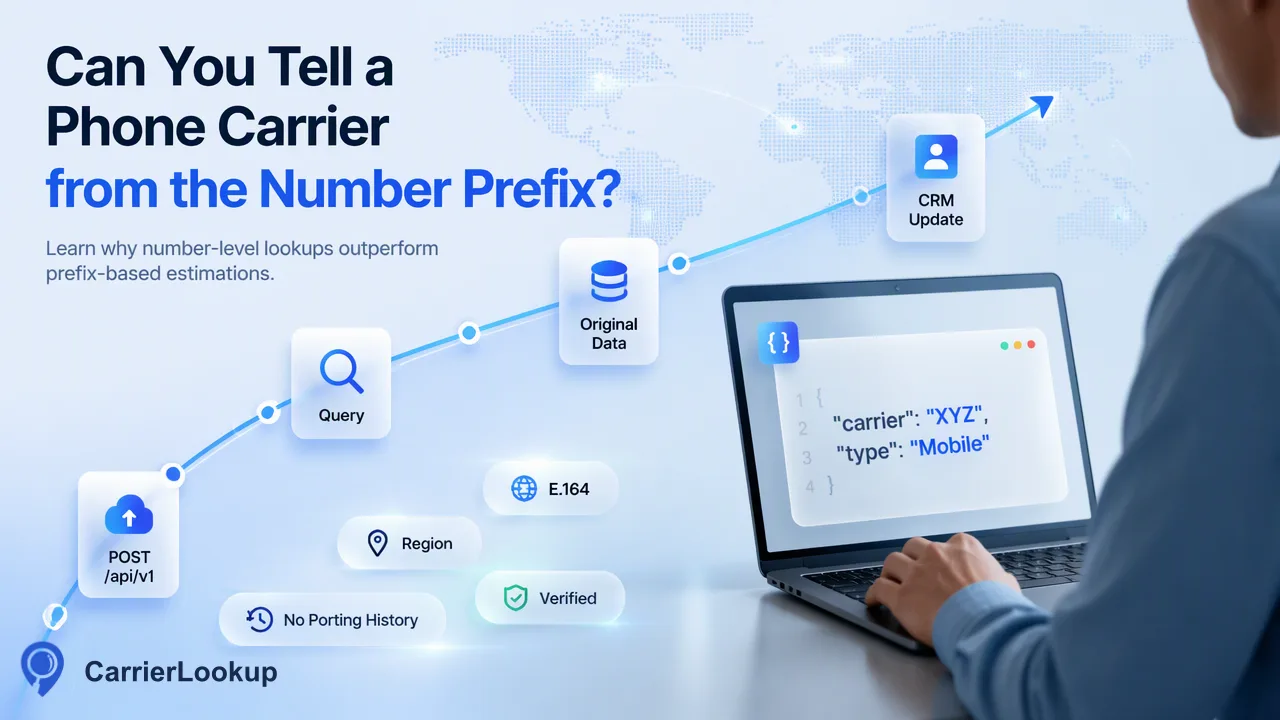
A decision guide for choosing a prefix table or a number-level original carrier lookup.
A phone number prefix can suggest where a number range was originally allocated, but it cannot reliably identify the carrier serving a specific number today. Numbering plans and allocation tables describe ranges; portability lets customers keep numbers after changing providers. CarrierLookup's Original Carrier Lookup returns original carrier, underlying carrier, number type, and allocation geography when available. That is more specific than a broad prefix guess, yet it is still not a current-carrier or reachability check. Use a prefix table for rough categorization, and use a number-level lookup when a contact record needs documented original allocation context. Keep any empty fields as unavailable.
What a phone number prefix can and cannot tell you
A prefix is the initial part of a telephone number after the relevant country code or national dialing prefix. National numbering authorities assign number blocks under their own plans. A table can show that a range was allocated to an operator or geographic category at a given time. For example, UK regulator Ofcom publishes allocation data for ranges and codes. That publication is useful background, but a table entry describes the allocation record, not the live state of every number beginning with those digits.
The meaning of a prefix also depends on the country and number type. Ofcom's area-code tool explains that UK 01 and 02 codes are tied to geographic areas, while other numbers are not necessarily linked to a place. Another country's numbering plan may divide its ranges differently. A rule written for one country should not be applied to an international CRM as if all prefixes followed the same length and allocation scheme.
A prefix guess is often sufficient for low-stakes tasks such as rough data exploration or checking that a number's displayed country code is plausible. Label it as an estimate based on a range. It is insufficient when a team needs a number-level record of original carrier and number type, and it cannot resolve whether a customer ported to another provider. Treat a spreadsheet prefix column as a research aid, not a definitive operator field.
Why portability breaks the current-carrier inference
Number portability allows a customer to retain a phone number after changing provider under applicable national rules. Ofcom describes portability for landline and mobile numbers. Once a number has been ported, the digits still reflect their historic allocation pattern, while the provider serving the number can differ. A prefix table cannot observe that change in a particular subscriber's current arrangement. A range's original carrier and today's network are different questions.
This distinction applies even to a fresh lookup if the product is designed to return original allocation. CarrierLookup's carrier field reports the carrier to which the number range was originally allocated. It does not publish a current-carrier service. The word realtime describes how quickly a single or multi request returns its result; it does not turn the result into live network status. Label the value as original allocation so a reader can interpret it correctly.
A careful data model stores original carrier as the label. It may also store lookup date and source product as internal provenance. Those are suggested CRM labels, not a promise that the product reports a porting history. If the business decision genuinely requires the present provider, the team needs an appropriate separate source. Do not derive one by comparing a static prefix guess with an original carrier field; two allocation-based observations do not become a live network check when combined.
When a number-level lookup adds value
A number-level Original Carrier Lookup is useful when a team needs to attach documented original allocation context to individual records. It can return the original carrier and underlying-carrier names, number type, country code, region, and city when available. That is more granular than assigning every number sharing a short prefix to a broad category. The number type can help distinguish mobile and fixed-line records in a mixed list, while allocation geography may help inspect an obviously inconsistent source record. Neither field is evidence of a subscriber's identity or location.
Prepare a realtime input in E.164 form, with a leading plus sign, country code, and number without spaces or separators. The documented single route is POST /api/v1/check. POST /api/v1/batch-check handles a synchronous multi request and preserves input order. The multi route can include numbers from different countries, but the team should still normalize each country under its own rules before calling it. For a large, essentially one-country list, the distinct Global carrier lookup uses an asynchronous TXT or CSV file task. Select the route that fits the workload rather than sending a file to a synchronous endpoint.
A completed lookup may return empty optional carrier fields. Record them as unavailable instead of inventing an operator from the prefix. A rejected format or undetermined check requires its own review path. The team can use a prefix table to flag surprising results for manual inspection, but the table should not overwrite the product's normal result. This keeps the origin of every carrier label visible.
Choose a prefix table or lookup by the decision at hand
For a one-time overview of a country's numbering plan, start with the regulator's published allocation material. It can answer broad questions about which ranges are designated for geographic, mobile, or other categories. Record the date of the material, because range assignments and plan rules can change. A rough segment such as 'numbers beginning with a known geographic area code' may be adequate for planning a manual review. State the confidence and source rather than promising a specific carrier for each subscriber.
For CRM enrichment or repeated operational use, a number-level original-carrier result may provide clearer provenance. Decide whether the team needs one new record, a synchronous group of new records, or a larger file. Keep the original phone string, normalized number, lookup route, result date, and returned fields separate. If the team later groups by carrier or number type, include an unavailable category rather than forcing every row into a named carrier. This is especially important when a bulk file contains records from several source systems with different formatting quality.
The API documentation describes current route contracts and product-specific file conditions. For the file route, use one country-coded number per line in TXT or CSV and select one country. Poll a bulk task no more often than every 30 seconds; a successful task returns one CSV. Avoid extending a prefix table with guessed current-carrier data, and avoid treating the lookup CSV as a promise about delivery or activity. The method should match the question, not simply the file size.
Explain the result to the next person
A useful report says, 'This was the original carrier returned for this number,' or, 'This prefix falls in a range shown by the regulator's table.' It does not say, 'This person currently uses this carrier,' unless a different source actually supports that claim. Describe region and city as allocation geography and number type as a returned classification. If a value is empty, write 'unavailable' rather than 'none.' These labels help a later reviewer distinguish source data from the team's interpretation.
Before a messaging or calling decision, confirm the other evidence needed for that workflow. A carrier result does not show that a line is active, reachable, opted in, or controlled by the contact in the CRM. It can still help an operations team organize review queues or compare allocation patterns across lists, provided the limitations stay visible. A prefix is a clue about a range; a number-level original carrier lookup is a more specific allocation observation. Neither is a live subscriber record.
FAQ
Can a prefix reveal the exact carrier of a ported number?
No. A prefix can point to an original allocation range, but portability can leave the digits unchanged after a provider switch. CarrierLookup also reports the original carrier, not the current one. If the present provider matters, use another source designed for that question rather than treating a prefix or original allocation value as live network evidence.
Is a number-level lookup useful if the prefix table is available?
It can be. A prefix table is useful for broad plan research, while a lookup returns documented context for the specific number, including number type and original allocation fields when available. The value is in the more precise, source-labeled record. Empty fields remain unavailable, and the lookup still does not prove current carrier or reachability.
Can teams use an area code as the caller’s location?
No. An area code or returned region and city describe numbering allocation geography. They do not locate the person or device at the time of a lookup. A team can use that context to inspect a data-quality discrepancy, but should not convert it into a residential address or live-location claim.
Learn More
Choose the product information that fits the next step in your workflow.