
Product guidance
Phone Number Lookup Capabilities: What You Can and Can't Verify
Understand phone number lookup limitations and capabilities. Learn how teams use original carrier and allocation geography data for CRM hygiene.
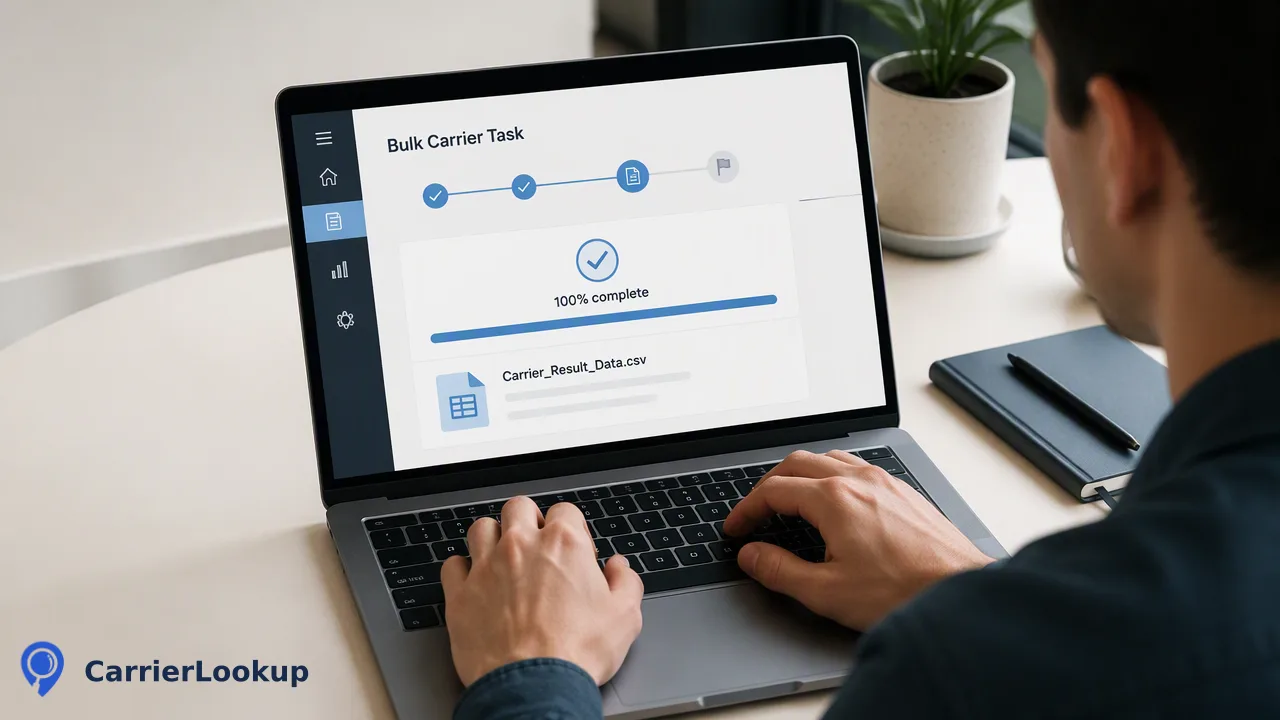
An overview of phone number lookup limitations, explaining how teams use original carrier and allocation geography data to improve CRM data hygiene and segmentation.
When evaluating phone number lookup limitations, organizations must distinguish between static allocation data and dynamic network states. CarrierLookup provides original assigned carrier context, line type, and regional assignment details through a web dashboard, REST API, and MCP. These lookup results provide original allocation context, not real-time status, current carrier information after portability, or physical device location. By retrieving the original network provider and allocation geography, teams can segment contact lists, standardize CRM records, and inform internal routing decisions. Understanding these specific capabilities helps technical and business teams integrate carrier signals effectively into their broader data hygiene workflows.
Understanding Phone Number Allocation Data
To effectively utilize phone number intelligence, teams must understand the specific data points returned by a carrier lookup. CarrierLookup focuses on the original network allocation of a phone number. Teams can access this data through the web dashboard for manual reviews, integrate the REST API for automated workflows, or utilize the MCP for specialized system integrations. When a system queries a number, the synchronous results can include the carrier, number_type, country_code, region, and city allocation fields. If specific data points are unavailable for a given number, the corresponding fields are returned as empty strings. The region and city fields describe the number-allocation geography. This data reflects the city or region associated with a phone number based on its exchange code. It provides structural context for the number's origin. Organizations use this allocation geography to organize records by region or to standardize formatting across international datasets. By relying on the original assigned carrier and line type, data operations teams gain a consistent baseline for categorizing phone numbers within their customer relationship management systems.
Synchronous Checks for Immediate Workflows
For workflows requiring immediate data retrieval, CarrierLookup offers synchronous processing through its REST API. The POST /api/v1/check endpoint performs an API-key single check, returning the carrier signal, line type signal, and allocation geography signal for a single supported phone number. When teams need to process small groups of numbers simultaneously, the POST /api/v1/batch-check endpoint handles 1 to 100 identifiers synchronously in input order. Interpreting the response fields correctly is a critical part of managing phone number lookup limitations. In a single check, a response of registered=true means that allocation data was found for the requested number. Conversely, registered=false is a normal no-allocation-data result. For synchronous multi-number rows, the API uses the exists field to indicate whether it has a normal result. A response of exists=false simply means no allocation data is present. Teams use these synchronous endpoints to enrich incoming leads or validate data formatting at the point of entry.
Asynchronous Processing for Large Datasets
When organizations need to audit extensive historical databases or prepare large contact lists for segmentation, synchronous endpoints are often less efficient. For these high-volume requirements, CarrierLookup provides bulk carrier tasks using the carrier_batch service type. This asynchronous bulk processing capability supports lists containing 1,000 to 100,000 valid phone numbers from one country. During a bulk operation, the system processes the provided phone file asynchronously and generates a downloadable result file containing the carrier, line type, and allocation geography signals. This method allows data engineering teams to submit large batches of records without maintaining an open connection, freeing up system resources for other tasks. By utilizing the carrier_batch service type, organizations can systematically update their legacy CRM records, apply consistent line-type categorization across thousands of entries, and prepare segmented lists for subsequent internal review processes.
Best Practices for CRM Data Hygiene and Segmentation
Integrating carrier and allocation data into daily operations requires a structured approach to CRM data hygiene. Organizations use lookup data to organize and segment contact lists based on the original assigned carrier and line type. For example, separating mobile line types from fixed-line numbers helps teams tailor their communication routing strategies and format their outreach appropriately. Lookup results should inform internal review processes and structural organization. By appending the country_code, region, and city allocation fields to customer profiles, data teams can group records by their allocation geography. This segmentation supports regional territory planning and helps maintain consistent data formatting standards across the enterprise. When a CRM contains standardized country codes and line types, internal reporting becomes more accurate, and data engineering teams spend less time resolving formatting discrepancies. Consistent data hygiene improves operational efficiency by providing reliable context for CRM records, ensuring that downstream systems have the necessary structural information to process phone numbers correctly.
FAQ
What fields are included in a synchronous carrier lookup?
Synchronous results from CarrierLookup can include the carrier, number_type, country_code, region, and city allocation fields. These fields provide the original assigned carrier and the number-allocation geography. If a specific data point is unavailable for the requested phone number, the API returns an empty string for that field.
How does the API handle numbers without available allocation data?
In a single check using the POST /api/v1/check endpoint, a response of registered=false is a normal no-allocation-data result. For synchronous multi-number rows via POST /api/v1/batch-check, the exists field indicates whether a normal result is present; exists=false means no allocation data was found.
What is the difference between single checks and bulk carrier tasks?
Single checks use the POST /api/v1/check endpoint for immediate, synchronous retrieval of one identifier. Bulk carrier tasks use the carrier_batch service type to process a same-country list of 1,000 to 100,000 valid phone numbers asynchronously. The bulk process concludes by providing a downloadable result file.
How should organizations use allocation geography in their CRM?
Organizations use the region and city allocation fields to understand the number-allocation geography based on exchange codes. This data helps teams segment contact lists, standardize regional formatting, and inform internal review processes. It provides structural context for organizing CRM records by their original regional assignment.
How many identifiers can be processed synchronously?
The POST /api/v1/batch-check endpoint handles 1 to 100 identifiers synchronously in input order. This allows systems to process small groups of phone numbers immediately without initiating an asynchronous bulk task, making it suitable for real-time data entry workflows or immediate CRM enrichment.