
Product guidance
How to Clean Your CRM Data to Reduce SMS Costs and Improve Reach
Optimize CRM records with phone number list cleaning. Use carrier allocation and line-type data to cut wasted SMS spend and route outreach accurately.
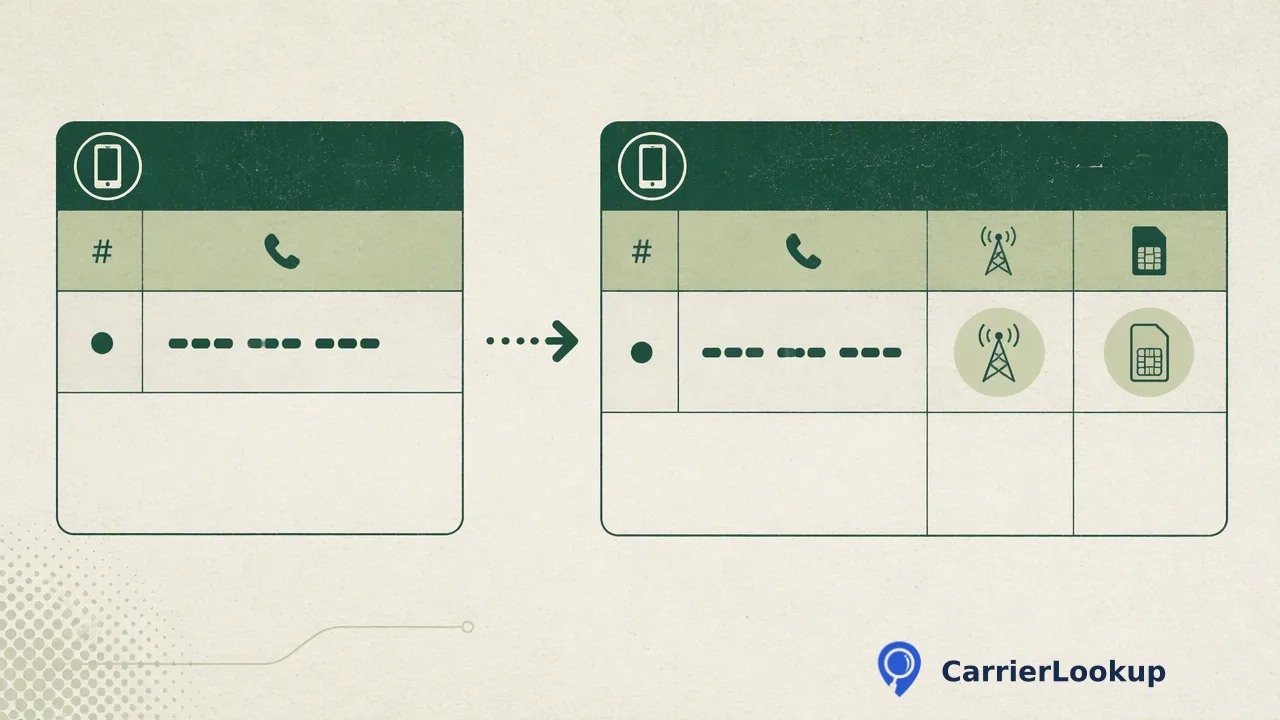
Learn how phone number list cleaning uses carrier allocation and line-type metadata to audit CRM databases, filter out non-mobile numbers, and improve SMS campaign efficiency.
Phone number list cleaning involves auditing customer relationship management records against carrier allocation data, line-type classifications, and regional geography to prepare contact lists for messaging campaigns. By identifying whether an individual record represents a mobile, fixed line, or VoIP allocation, organizations can route outreach appropriately and avoid sending SMS traffic to numbers incapable of receiving text messages. Integrating carrier allocation metadata into CRM hygiene routines supports budget efficiency by filtering out incompatible entries, improving audience segmentation, and establishing auditable records without relying on unverified assumptions about device reachability.
The Financial Impact of Unverified CRM Phone Records
Maintaining unverified phone numbers in a CRM creates recurring operational waste whenever marketing or support teams initiate outbound text messaging. When organizations launch SMS outreach against uncleaned lists, a measurable portion of the message volume inevitably targets fixed-line desk phones, incompatible VoIP configurations, or unallocated ranges. SMS gateway providers routinely invoice teams for every dispatched transmission attempt, regardless of whether the destination endpoint supports mobile messaging. Over large customer databases, sending high-volume notifications to invalid or misclassified records inflates messaging bills and distorts campaign engagement reporting. Inaccurate data also consumes downstream operational bandwidth, triggering false delivery failures that marketing and engineering teams must troubleshoot. Conducting systematic phone number list cleaning prior to message scheduling establishes an essential baseline of operational hygiene, helping organizations remove non-viable destinations from active send lists and focus budgets exclusively on valid, message-compatible contacts.
Understanding Carrier Allocation Context and Data Signals
A fundamental requirement of data hygiene is distinguishing between historical carrier allocation metadata and live subscriber status. Regulatory bodies assign telephone number series to telecommunication networks in predetermined blocks. Carrier lookup queries return this initial network assignment, identifying the assigned operator alongside regional administrative details such as city, region, and international country code. Because carrier allocation details reflect network assignment blocks rather than live subscriber telemetry, teams must treat these attributes as structural context rather than proof of current device status. For instance, receiving an empty string or a standard unallocated response indicates that regulatory allocation records were not found, rather than confirming that a line is permanently dead or disconnected. Similarly, allocation geography reflects the geographic registration boundary assigned to the number prefix, rather than a subscriber's immediate physical presence or real-time location. Understanding these distinctions ensures CRM administrators segment records accurately without making false operational assumptions.
Segmenting Audience Lists Using Line-Type Metadata
Line-type classification serves as the primary technical filter for multi-channel communication strategies. Phone records generally classify into mobile, fixed-line, or virtual categories. By appending line-type signals to CRM profiles, teams can programmatically segregate records prior to campaign execution. | Line Type | Channel Compatibility | Recommended Operational Action | | :--- | :--- | :--- | | Mobile | Direct SMS, MMS, Voice | Route to primary SMS campaign queues. | | Fixed Line | Voice only | Direct to voice outbound or direct mail; exclude from SMS. | | VoIP / Other | Mixed / Conditional | Flag for customer review or fallback verification. | Filtering fixed-line numbers out of SMS databases preserves marketing capital and eliminates delivery errors caused by network protocol incompatibility. Furthermore, auditing these metadata tags helps operational teams prioritize manual reviews for accounts with incomplete contact parameters, directing resources where direct engagement is structurally feasible.
Implementation Best Practices for CRM Hygiene Workflows
Establishing sustainable contact maintenance requires combining real-time intake audits with periodic batch reconciliation. When users submit contact details through registration portals, synchronous carrier checks can instantly evaluate whether the input corresponds to an expected mobile line type before storing it. For legacy CRM databases, processing batches through dedicated list-cleaning workflows allows organizations to evaluate existing archives systematically. Teams should implement a repeatable lifecycle for contact management:
- Standardize all imported records to conform to consistent numbering parameters. 2. Execute batch carrier lookups to retrieve assigned operator, line type, and allocation geography. 3. Segment audiences by tagging verified mobile numbers for messaging while isolating landline records for alternative channels. 4. Archive unallocated or indeterminate records into an audit queue rather than continuously attempting outbound delivery. This structured workflow maintains clean contact records over time, curbs wasteful telecommunications expenditure, and informs strategic outreach planning across all regional segments.
FAQ
Why is carrier allocation data important for SMS marketing?
Carrier allocation data identifies the regulatory network assignment and line type associated with a telephone number. This information allows marketing teams to confirm whether a contact is allocated as a mobile line capable of receiving standard text messages, helping organizations avoid spending campaign funds on non-mobile allocations.
Does carrier lookup indicate whether a phone number is currently active?
Carrier lookup returns allocation context—such as network assignment, line type, and geographic boundaries—based on regulatory allocation data. It does not inspect live device power, active subscriber use, mobile network registration, or current call-reception states.
How does line-type classification help reduce marketing costs?
Line-type classification categorizes numbers as mobile, fixed line, or VoIP. Because traditional fixed lines cannot accept SMS transmissions, identifying these records allows marketing teams to exclude them before sending messages, preventing unnecessary dispatch fees and routing errors.
Learn More
Choose the product information that fits the next step in your workflow.