
What Is Original Carrier Lookup? Definition and Workflow Guide
Learn what original carrier lookup is, how it differs from ported carrier status, and how teams use allocation geography and line type data.
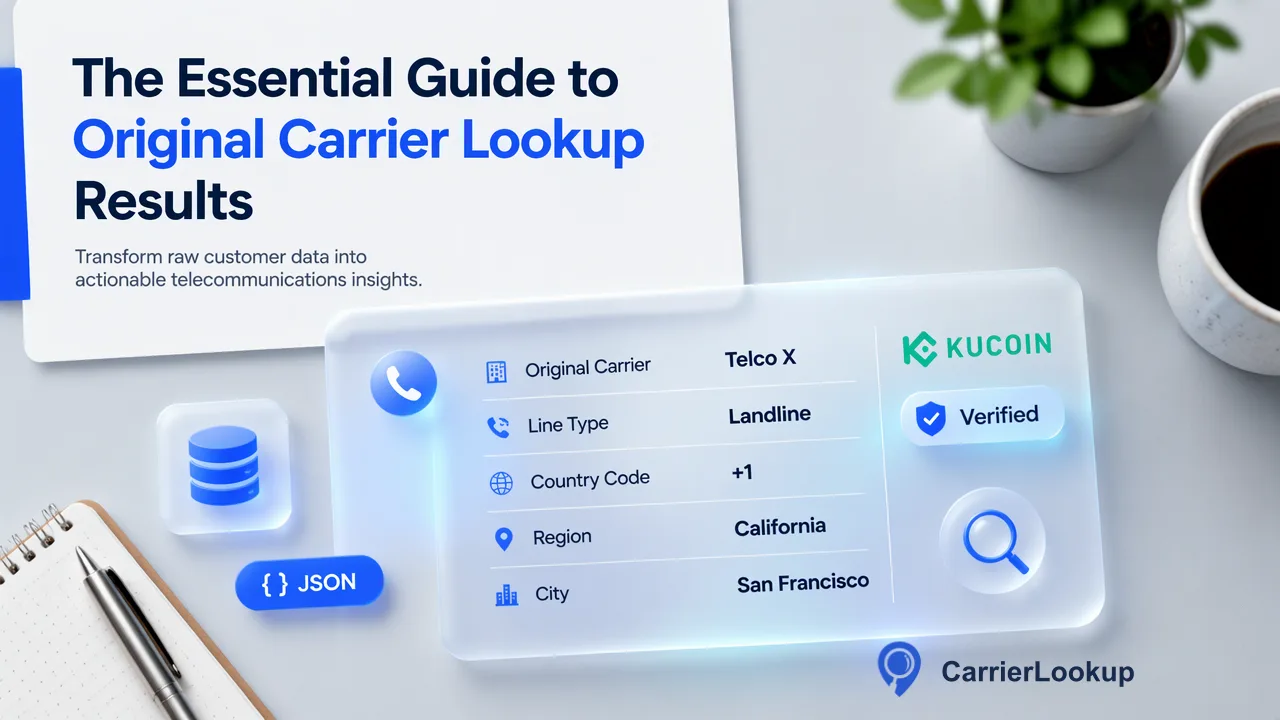
Original carrier lookup identifies the telecommunications provider, line type, and geographic area originally assigned to a phone number range, providing baseline telecommunications context for data workflows.
Original carrier lookup is a telecommunications data query that identifies the network operator, line type, and geographic area to which a phone number block was originally allocated. Rather than querying live routing databases to detect active network handoffs, an original carrier lookup examines the baseline assignment recorded in official numbering plans. The resulting record returns historical allocation context, such as the original carrier name, underlying carrier, line type, country code, region, and city. Organizations use this data to categorize phone records, route communications, and add structural telecommunications context to customer data pipelines without attempting to track real-time device status.
Defining Original Carrier Lookup
An original carrier lookup queries national and international numbering databases to retrieve the administrative baseline of a specific phone number. When telecommunications authorities distribute numbering resources, blocks of numbers are assigned to licensed carriers for designated services and geographic zones.
A completed query typically returns several core attributes:
- Originally Allocated Carrier: The telecommunications provider that received the initial block assignment.
- Underlying Carrier: The wholesale carrier or network infrastructure provider associated with the numbering block.
- Line Type: The technical category of the number, such as mobile, landline, or VoIP.
- Allocation Geography: The country code, region, and city designated in the telecommunications numbering plan.
Formatting standardizes these queries under international conventions, such as ITU-T Recommendation E.164, which limits international phone numbers to fifteen digits starting with a country code. Organizations can integrate these lookups through the Original Carrier Lookup API for real-time evaluations or review How CarrierLookup works across high-volume pipelines.
Original Allocation vs. Post-Porting Status
A critical technical distinction in telecommunications data is the difference between initial allocation and current serving network status. Under regulatory frameworks like Porting: Keeping Your Phone Number When You Change Providers, consumers can retain their existing phone numbers when switching service providers within the same geographic area.
Because number portability decouples the physical subscriber from the original numbering block, the carrier that currently routes calls or text messages may not match the carrier that originally received the block assignment. Original carrier lookup specifically answers which carrier owns the historical allocation block, not which network currently hosts the subscriber.
Teams evaluating carrier data must distinguish between these use cases:
| Data Field | What It Represents | What It Does Not Represent |
|---|---|---|
| Original Carrier | The carrier originally assigned the numbering block | Current network after porting |
| Line Type | Initial category (mobile, landline, VoIP) | Real-time device connection state |
| Allocation Geography | Regulatory city or region assignment | Live GPS or physical user location |
For systems that process asynchronous batches of records, services such as Global carrier lookup return these baseline fields across prepared files without querying live routing engines.
Understanding Allocation Geography
Telecommunications plans structure telephone numbers hierarchically, associating specific area codes and exchanges with geographic regions. In an original carrier lookup, the returned region and city values indicate where the national numbering administrator assigned that exchange.
These geographic markers do not provide real-time subscriber tracking. A mobile subscriber with a number allocated to a specific metropolitan exchange can travel globally, relocate permanently, or operate over roaming networks without altering the underlying numbering assignment. Allocation geography describes the record itself, never the current coordinates or roaming status of a mobile device.
Treating allocation geography as metadata rather than real-time tracking also supports regulatory data hygiene, such as the data minimisation principle defined under GDPR Article 5 (Regulation (EU) 2016/679). Teams can categorize demographic context without capturing intrusive device telemetry.
Practical Applications in Business Workflows
Organizations incorporate original carrier lookup data to support administrative data management and customer onboarding logic. While the lookup does not guarantee delivery or prove subscriber identity, it provides consistent telecommunications context alongside internal customer records.
Communication Routing and Prioritization
Identifying the line type associated with an incoming record helps teams separate landline allocations from mobile ranges. This distinction allows automated systems to route landline entries away from SMS-only queues toward alternate communication channels.
Risk Review and Decision Support
Risk and compliance teams frequently use carrier allocation attributes as one input among multiple review signals. Identifying whether an incoming lead uses a VoIP range or a traditional mobile carrier provides structural context that can inform customer-defined verification or step-up procedures.
Implementation Context
Technical teams can consult the CarrierLookup API documentation to implement single or multi-number synchronous checks, explore automated workflows through Carrier Lookup Pricing options, or connect internal agents directly by reading the CarrierLookup MCP docs.
FAQ
Does original carrier lookup show the current carrier after a number is ported?
No. Original carrier lookup identifies only the provider to which the numbering block was first assigned. In markets where subscribers can transfer numbers between wireless, wireline, or IP providers, the current serving network may differ from the initial allocation. The query does not track live routing modifications or ongoing portability transactions.
Is allocation geography the same as a user's live physical location?
No. Region and city attributes in an original carrier record represent the administrative numbering geography assigned to that range when it was first created. They do not represent GPS coordinates, cellular tower connections, billing addresses, or the current physical location of a subscriber or mobile device.
Can carrier lookup confirm if a phone number is currently active or reachable?
No. A carrier lookup confirms only the administrative allocation parameters of the numbering range. It does not establish network validity, active line subscription, call or SMS reachability, device connection, account ownership, or subscriber consent for messaging campaigns.
Learn More
Choose the product information that fits the next step in your workflow.