
Product guidance
Why Prefix-Based Routing Fails: The Impact of Number Portability on Global SMS Delivery
Learn why mobile number portability makes prefix-based routing obsolete and how carrier allocation context supports modern global SMS delivery workflows.
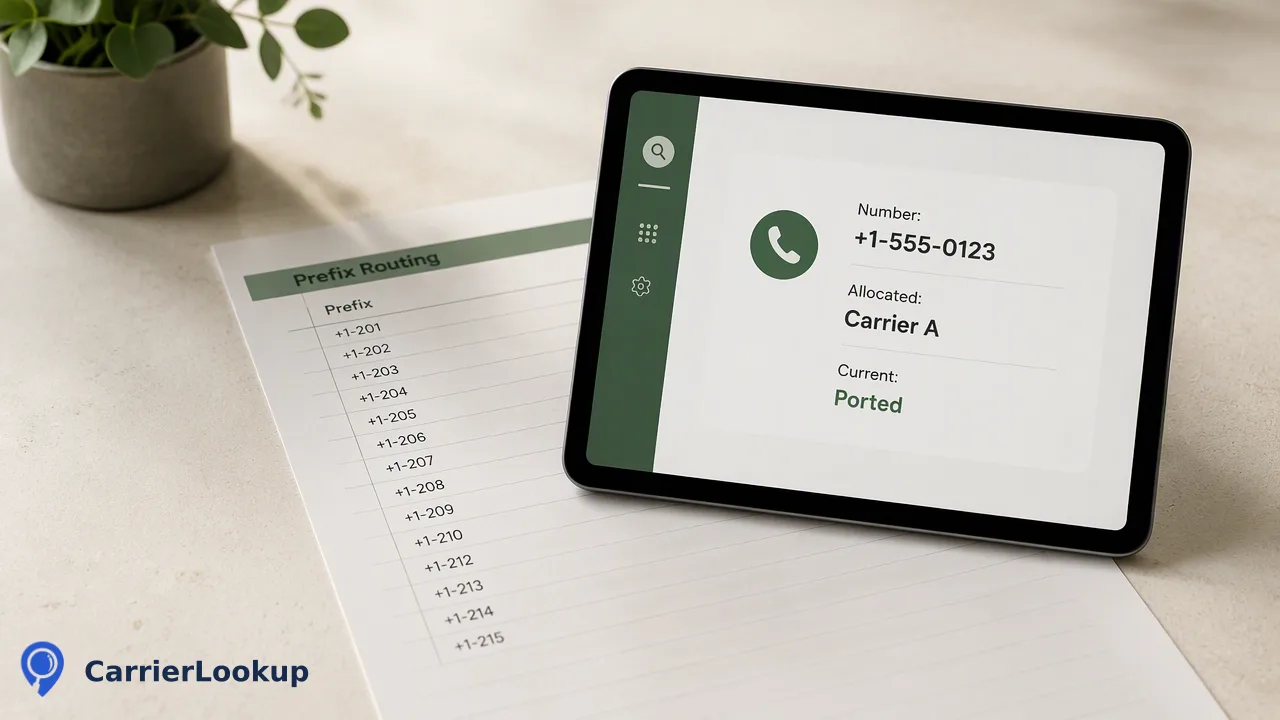
Mobile number portability breaks static prefix routing for SMS delivery. Learn the difference between allocated and current carriers and how dynamic lookup context supports messaging workflows.
Mobile number portability has rendered prefix-based routing obsolete because phone numbers no longer stay permanently tied to their originally assigned networks. Relying strictly on static prefix tables leads to routing inefficiencies, higher delivery friction, and increased latency across global SMS operations. When subscribers switch providers while retaining their numbers, static prefixes point to historical network assignments rather than current routing paths. To maintain resilient messaging workflows, technical teams integrate number portability lookup data and carrier allocation context. Real-time carrier data helps organizations identify allocation details, segment phone records effectively, and inform routing decisions alongside active delivery telemetry.
The Evolution of Mobile Number Portability and Prefix Decay
Historically, telecommunications routing relied on national numbering plans where specific digit prefixes mapped directly to designated network operators. Messaging gateways inspected the initial digits of an E.164 number to identify the recipient network. The widespread adoption of mobile number portability (MNP) fundamentally altered this model. Regulatory frameworks worldwide allow subscribers to change mobile service providers while retaining their existing telephone numbers. As a result, a prefix indicates only the network that originally received the block allocation from a telecom authority. In markets with mature portability mechanisms, large volumes of platform account-presence signals no longer route through their allocated networks. Continuing to use static prefix databases introduces systematic routing errors, as messages are repeatedly directed toward original carriers that no longer service those subscribers.
Allocated Carrier vs. Current Carrier: Understanding the Split
Maintaining reliable SMS delivery requires distinguishing between original allocation data and current serving networks. Original allocation represents the network provider and geographical region—such as a specific state, province, or city—to which a regulatory body initially assigned the number range. Carrier lookup tools inspect available numbering plans to surface this context, returning attributes like carrier name, line type, country code, region, and city. However, these fields reflect assignment history rather than the real-time physical location of a handset or its current serving carrier after a port. Recognizing this distinction helps engineering teams avoid false assumptions during routing. Carrier data provides structural allocation context, whereas portability tools assess whether that assignment has shifted. When teams treat original assignment as an immutable operational fact, routing systems fail to account for ported subscribers, resulting in downstream handoff friction.
Operational Inefficiencies of Static Routing Tables
Operating an enterprise messaging pipeline with static routing tables introduces compounding technical and financial friction. When an SMS application dispatches traffic based purely on static prefix tables, messages destined for ported numbers are sent to the original network operator. That initial operator must either reject the message or perform an out-of-path inter-carrier query to forward the payload to the actual recipient network. This intermediary handoff introduces measurable latency, which degrades time-sensitive workflows such as transactional alerts and authentication codes. In more severe cases, misrouted packets encounter transit timeouts, dropped connections, or carrier-level filtering, leading to delivery failures. Furthermore, intermediaries may assess surcharges for rerouting misrouted traffic. Because static databases require continuous manual updates yet perpetually lag behind daily porting activity, they remain poorly suited for modern, high-volume messaging.
Best Practices for Integrating Portability and Carrier Signals
Modern communications architectures achieve higher routing reliability by pairing static hygiene with automated lookup signals. Integrating a number portability lookup into data pipelines enables teams to segment lists and inform downstream messaging strategies before dispatch. First, evaluate line type: identifying whether a record is mobile, landline, or VoIP helps systems suppress SMS traffic toward non-SMS-capable destinations, preserving operational budget. Second, utilize carrier allocation context to inform multi-vendor routing rules, balancing routing paths according to regional network relationships. Third, treat lookup signals as decision-support inputs rather than deterministic proofs of reachability, active handset state, or user identity. Carrier lookup tools like CarrierLookup provide allocation context through synchronous APIs for single and small-batch checks, as well as asynchronous bulk processing for larger list audits. Integrating these signals alongside active delivery receipts creates a feedback loop that continuously refines delivery performance.
FAQ
Does a carrier lookup confirm whether a phone number is currently active?
No. A carrier lookup returns structural allocation data, such as the original carrier, line type, and geographic assignment, rather than real-time network connectivity. Receiving allocation records confirms that numbering data exists, but it does not establish device power, active subscriber status, network reachability, or consent to receive messages. Teams should use carrier data to inform routing logic rather than verify line activity.
Why does carrier data show a different provider than the user's current network?
Carrier lookup queries frequently surface original allocation data, which reflects the telecommunications operator that originally received the number block from regulatory authorities. When a subscriber ports their number to a new provider through mobile number portability, their active network changes while the underlying assignment history remains unchanged. Systems should treat allocation data as assignment context rather than a guarantee of current carrier status.
How can organizations use allocation data to improve SMS routing?
Organizations can use allocation data to inspect line types and suppress numbers incapable of receiving text messages, such as fixed landlines. Additionally, allocation context helps teams categorize records by country, region, and original network, enabling more structured routing policies across external SMS gateways. Combining this allocation baseline with live delivery telemetry supports more reliable routing choices and reduces unnecessary messaging attempts.
Learn More
Choose the product information that fits the next step in your workflow.