
Product guidance
Why Mexico's Number Portability Makes Prefix-Based Routing Obsolete
Learn why Mexico's number portability makes prefix-based routing obsolete and how dynamic carrier lookup supports data hygiene and routing accuracy.
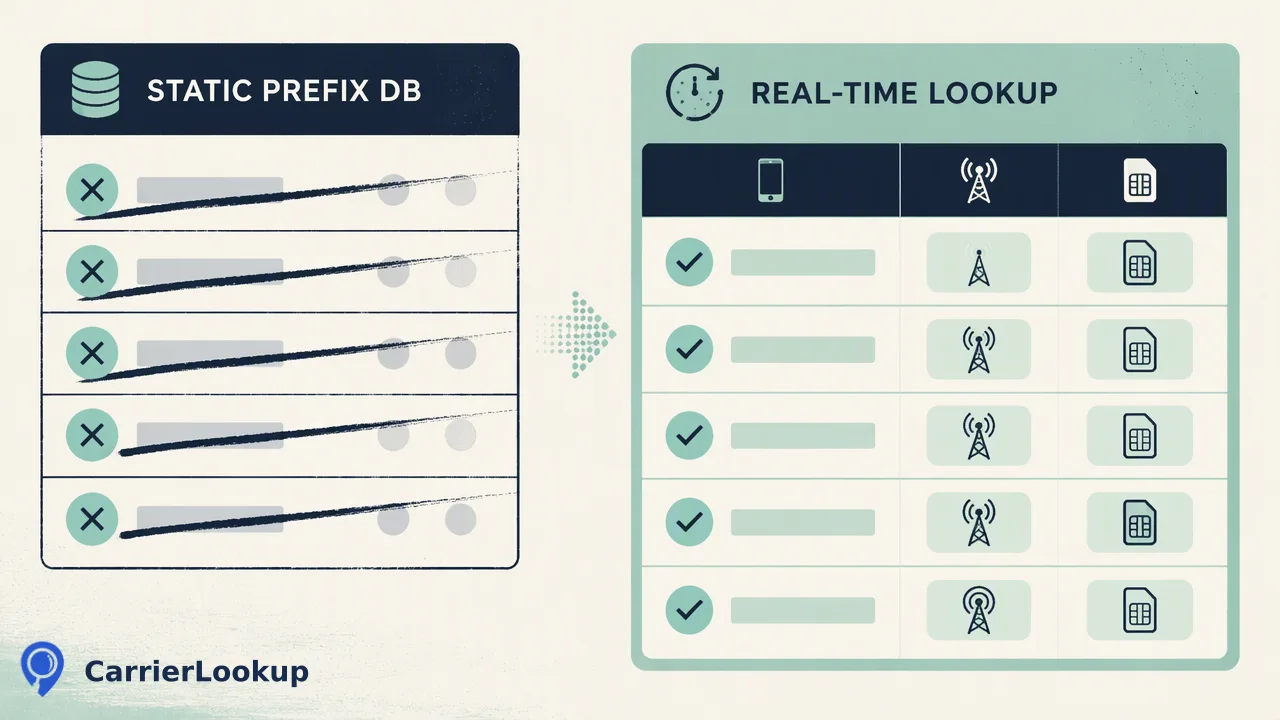
Number portability in Mexico breaks static prefix-based routing by separating telephone prefixes from current service providers, making dynamic carrier lookup essential for telecommunications accuracy.
The primary number portability impact in telecommunications is the decoupling of a phone number's initial digits from its operating network. In markets like Mexico, subscribers regularly change service providers while retaining their ten-digit numbers. Prefix-based routing relies on the outdated assumption that initial area codes and number blocks permanently identify the assigned network. Because ported lines diverge from initial block assignments over time, static prefix lookup tables lead to routing errors and inefficient delivery paths. Managing phone records in portable environments requires dynamic carrier lookup solutions that return available carrier and line-type allocation fields rather than relying on legacy prefix rules.
The Evolution of Phone Number Routing
Telecommunications routing historically relied on geographic numbering plans and centralized block allocations. In this legacy model, telephone regulators assigned distinct blocks of initial digits to specific service providers within defined geographic areas. Telecommunications systems used prefix-based routing to determine the destination operator simply by parsing the first few digits of an incoming number. Because numbers remained tethered to their original networks, static routing tables were sufficient to determine the intended recipient carrier. This architecture functioned effectively in a static regulatory environment where fixed-line and mobile subscribers had no mechanism to transfer numbers between competing operators. However, as mobile adoption accelerated and telecommunications authorities introduced subscriber portability, the foundational premise of prefix matching dissolved. In modern environments, a number's opening digits indicate where the line was initially registered, but they no longer verify which telecommunications operator currently serves that line.
How Number Portability Disrupts Static Databases
Number portability gives subscribers the regulatory right to switch telecommunications providers while retaining their existing telephone numbers. Each completed port separates the telephone number from its original network block. Over months and years, cumulative porting activity alters the network distribution of platform account-presence signals across the entire country. Mexico offers a clear example of this dynamic environment. The country streamlined its telecommunications framework by establishing a flat ten-digit national dialing plan and removing legacy domestic prefixes. While this standardized dialing mechanics, it also highlighted the limitations of static databases built on initial range allocations. When organizations store phone records in static databases without updating network metadata, the data becomes increasingly inaccurate over time. As subscribers port lines across mobile and fixed networks, local tables cannot track these movements, resulting in outdated carrier classifications across customer registries.
The Risks of Relying on Outdated Allocation Data
Relying on obsolete allocation data introduces technical friction and financial waste into communication pipelines. When communication platforms send SMS notifications, voice alerts, or authentication codes using prefix-inferred carrier tables, downstream aggregators must re-route or re-query messages across intermediate gateways. This mismatch leads to misrouted traffic, message latency, and increased operational costs. Furthermore, line-type misclassification complicates operational workflows. A number originally allocated as a landline might be ported to a mobile operator, or a commercial range might shift to a virtual provider. Without current carrier and line-type context, organizations risk sending SMS payloads to incompatible endpoints or misallocating communication budgets. Mismanaged outreach workflows undermine operational planning, making reliable allocation intelligence critical for telecommunications infrastructure.
Transitioning to Real-Time Lookup Solutions
To maintain high data hygiene in portable markets, technical teams are replacing static digit tables with dynamic lookup workflows. Modern data platforms query real-time allocation resources to return available carrier, line-type, and allocation-geography fields for target numbers. CarrierLookup provides carrier lookup capabilities through a REST API, web dashboard, and Model Context Protocol (MCP) integrations to support these operations. | Capability | Static Prefix Tables | Dynamic Carrier Lookup |
| :--- | :--- | :--- |
| Data Freshness | Stale; degrades as subscribers port lines | Dynamic; queries available allocation records |
| Line Type Context | Inferred from initial historical block ranges | Returns available line-type fields |
| Geographic Context | Fixed area code boundaries | Allocation-geography fields (region and city) |
| Operational Fit | Legacy telecommunications routing | Automated API and batch data hygiene |
For synchronous implementations, checking an individual number via POST /api/v1/check or submitting small lists via POST /api/v1/batch-check (supporting 1 to 100 identifiers synchronously in input order) returns carrier, line-type, and allocation-geography data. When processing larger customer databases, asynchronous batch tasks handle between 1,000 and 100,000 numbers from a single country under the carrier_batch service type. These tools help teams organize phone records and support routing logic without relying on static prefix assumptions.
FAQ
Why is prefix-based routing no longer reliable in Mexico?
Prefix-based routing assumes that a number's initial digits permanently identify its carrier. Following nationwide number portability and the shift to a uniform ten-digit dialing plan in Mexico, subscribers frequently change network operators while keeping their existing numbers. Consequently, static prefix maps no longer reflect current network assignments, leading to systematic misidentification of serving carriers when organizations depend on hardcoded dialing tables.
Does a carrier lookup confirm if a number is currently reachable?
No. A carrier lookup returns available carrier, line-type, and allocation-geography fields for a supported record. Teams use these allocation signals to inform downstream routing and filtering workflows rather than to verify real-time device connection.
How does number portability affect CRM data hygiene?
Number portability causes static contact records to degrade as subscribers transfer lines across telecommunications providers without changing their phone numbers. When internal systems rely solely on historical assignment databases, line-type classifications and network profiles become inaccurate. Performing carrier checks helps organizations update carrier and line-type context, supporting database organization and campaign segmentation across customer lists.
Learn More
Choose the product information that fits the next step in your workflow.