
MVNO Meaning: Brand Carriers, Host Networks and Lookup Results
MVNO means mobile virtual network operator: a provider that offers mobile service through access to another operator's radio network. The provider.
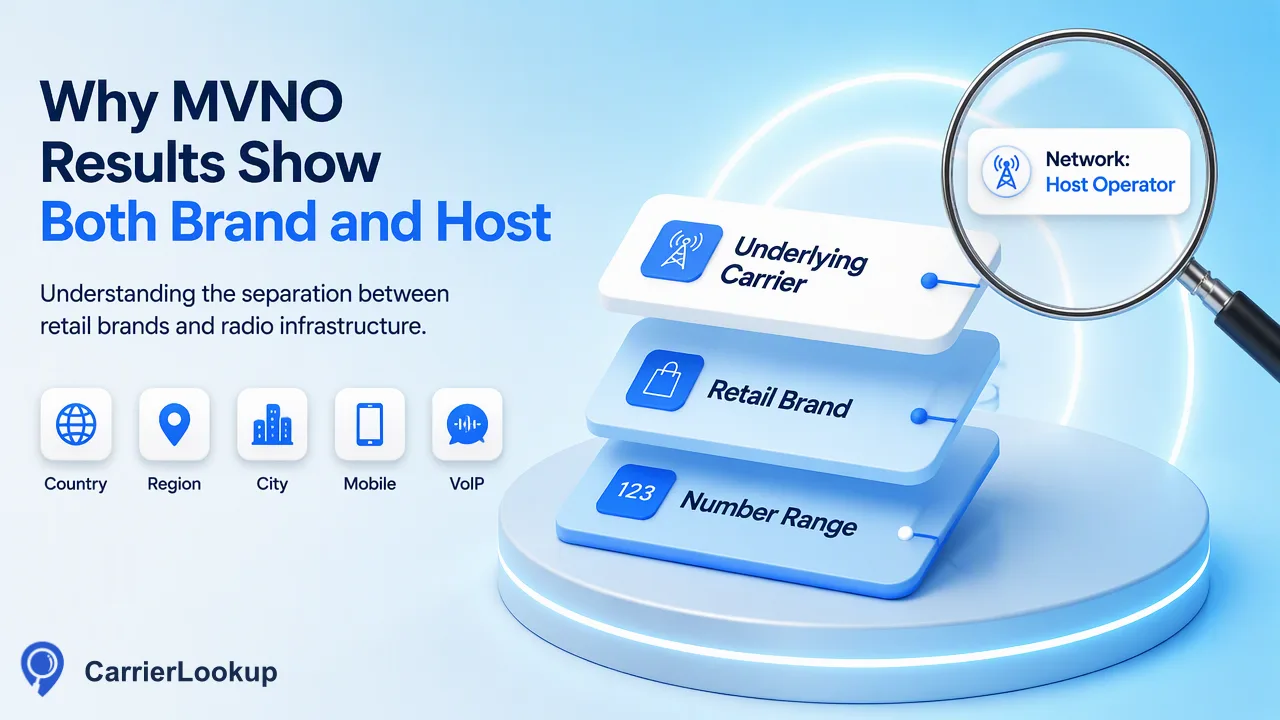
MVNO means mobile virtual network operator: a provider that offers mobile service through access to another operator's radio network.
MVNO means mobile virtual network operator: a provider that offers mobile service through access to another operator's radio network. The provider customers recognize may therefore differ from the infrastructure operator. In a carrier lookup, a carrier and an underlying carrier can provide distinct original-allocation context for a number range. Neither value alone establishes the network currently serving a ported number. Read the fields as separate labels, preserve blanks as unavailable, and avoid treating a familiar retail brand as proof of reachability or ownership. This distinction matters when teams group contact records or investigate why two operator names appear together.
MVNO meaning: a brand and a host can differ
Ofcom describes MVNO service as mobile phone service using the radio access network of a host operator. Some MVNOs operate more of their own technical systems than others, so the retail brand and infrastructure relationship is not identical across providers. The useful plain-language distinction is that one name may identify the customer-facing service while another identifies the host network behind part of that service. Do not assume that every number associated with an MVNO will display both names or the same relationship in every country.
A lookup result is a record about a particular number range, not a universal map of all MVNO partnerships. It may contain an original carrier and an underlying carrier, but a missing second value is an unavailable field, not a reason to manufacture a host. Likewise, a brand name alone is insufficient to assert the current serving network for a particular subscriber. The allocation record and the subscriber's present arrangement are different questions.
How to read carrier and underlying carrier
For CarrierLookup, the carrier value describes the operator to which the number range was originally allocated. The underlying carrier provides an additional carrier context when that value is available. In a brand and host relationship, these two labels can help a reviewer understand why a retail name and an infrastructure name might differ. Do not automatically rewrite the carrier column to match the underlying carrier. Store both under their own labels and preserve the raw result for later review.
The How CarrierLookup works page is a useful starting point for the product workflow. If a record returns both values, analysts should ask what decision they are making before selecting a grouping key. A customer-facing brand analysis may group by the original carrier value; a broader infrastructure review may inspect the underlying value separately. Neither grouping measures current coverage, network attachment, or delivery. If a result contains only one populated carrier-related field, report what is actually present rather than filling the other from a web search or a remembered partnership.
Why the result can differ from a customer expectation
A customer might name the brand on a bill, whereas a number-range result describes allocation history. The names may differ because the retail brand uses another operator's network, because the number was ported, or because the lookup field represents an earlier allocation. A mismatch is a reason to inspect field definitions and provenance before declaring an error. A result should not be treated as a live network test simply because the lookup request completed quickly. Realtime describes response timing; the carrier data remains original-allocation context.
Use a small review table when checking a discrepancy: source number in normalized form, lookup time, original carrier value, underlying carrier value if supplied, number type, and the reason the team expected another name. Keep the customer-provided brand in a separate field. This allows reviewers to identify whether the difference is between brand and host, historical and current context, or simply missing information. Avoid promising that the lookup can resolve the current relationship; a different authorized data source would be needed for that question.
Use MVNO context in a CRM without turning it into a verdict
For a new phone number, a realtime check can enrich the record with original carrier and number type. For a prepared back catalogue, a file task can return a CSV for reconciliation; the API documentation explains the supported routes and current limits. Use consistent field names in the CRM so analysts can distinguish carrier from underlying carrier. Store an explicit outcome for empty or undetermined results. Do not infer an MVNO label when the response does not support one.
A practical segmentation review begins with a question such as, “Which original allocation groups need manual review?” It then checks whether the group counts are driven by populated values or by missing data. If a business decision depends on live routing, reachability, identity, or consent, require a separate suitable source. The MVNO concept helps explain why operator labels may be different; it does not make a number lookup a live subscriber probe. This narrow interpretation makes the fields useful for data organization while leaving the operational decision to evidence designed for that decision.
If a report compares groups over time, keep the date of each lookup and the definition used for each column. A change in group counts may reflect newly added records, newly populated fields, or an updated source rather than a real change in subscriber networks. Show missing values as their own category. This makes trend charts more honest and helps a reviewer decide which records need another check instead of assuming every blank belongs to the largest known operator group.
FAQ
How can teams explain two carrier names in one result?
Explain the field definitions first. The carrier names the original range allocation, while an underlying carrier may add infrastructure context. An MVNO can present a retail brand while using a host operator's radio network. Keep both returned values under separate labels, then review the relevant number and source. Do not assume either value identifies the subscriber's current serving network.
Can teams identify every MVNO from a number lookup?
No universal MVNO classification follows from these fields. A record may provide a carrier value, an underlying value, both, or unavailable information. Team labels should reflect the returned data and any separately verified provider relationship. Missing underlying data should remain missing rather than being filled from a brand list that may change.
Does the underlying carrier prove that messages can reach a number?
No. The field adds carrier context for the original allocation record. It does not test whether a device is connected, whether a number is active, or whether a message can be delivered. For a delivery decision, use an appropriate separate process and do not promote allocation data into a reachability conclusion.
Learn More
Choose the product information that fits the next step in your workflow.