
Migrate a Mislabeled Carrier CRM Field with Mixed Sources
A mislabeled CRM carrier field should be migrated by source, not renamed in place. Inventory each feed that populated it, identify values proven to be.
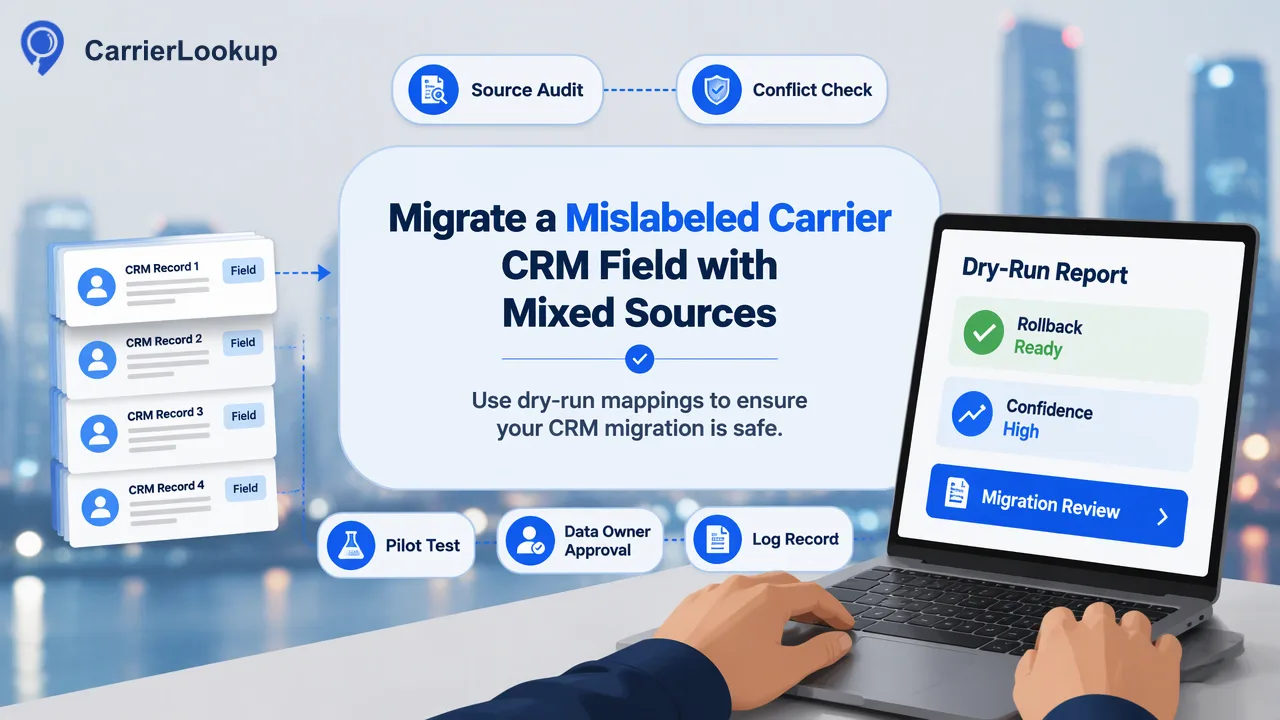
A mislabeled CRM carrier field should be migrated by source, not renamed in place.
A mislabeled CRM carrier field should be migrated by source, not renamed in place. Inventory each feed that populated it, identify values proven to be original allocation, and separate those from values whose current-network meaning cannot be verified. Export a rollback copy, run a dry-run mapping, then write CarrierLookup observations only to an explicitly labeled original-carrier field.
Audit the field before changing any records
A CRM field named 'carrier' can accumulate incompatible meanings over time. One integration may have stored original number-range allocation, another may have copied a salesperson's current-provider note, and a third may have imported an unknown third-party label. Start by listing every process that wrote the field, its date range, data dictionary and sample records. Do not infer a value's meaning from the operator name itself. A familiar carrier brand can appear in both an original-allocation result and a current-service claim.
CarrierLookup reports the carrier to which a number range was originally allocated. It does not publish a current-carrier or portability tracker. The Original Carrier Lookup product therefore supports only the original-allocation destination column. Mark each historic feed as proven original allocation, a separately defined attribute, or unknown. If evidence is missing, preserve the old value in a legacy or review field rather than migrating it into either semantic column.
Keep the source phone number and timestamp alongside each historic carrier value. If the contact phone changed, the old value may refer to a former number. Do not attach it to the current phone merely because it sits on the same CRM contact row. A source audit should count values by feed, age and confidence in meaning before any write occurs.
Design a reversible migration table
Create a new schema with fields such as original allocated carrier, original lookup source, checked number and observation date. Keep a separate current-network field only if the organization has a verified source and a defined use for it. Do not fill that field from CarrierLookup. For ambiguous legacy values, add a migration-review state and retain the raw value. This is a customer-side CRM design, not a product feature.
Export all affected records as a rollback copy, including IDs, phone values, old carrier values and last-edit versions. Build a dry-run mapping that reports what would move, remain unknown or conflict with a newer source. Do not let the dry run update production records. Review examples from each source feed with the data owner, and compare counts with the original export. A migration that cannot explain every removed or reassigned value is not ready to apply.
Portability makes the distinction important. The FCC's number-portability overview explains that customers may retain numbers when changing providers in its jurisdiction. That is general background, not evidence that a specific CRM number has ported. An original allocation value may remain useful even if current service changed; it simply belongs in the correctly labeled field.
Apply writes with conflict checks
At migration time, compare the current phone number and record version with the dry-run snapshot. If either changed, skip that row and send it to review. Otherwise write only the new original-allocation fields that have proven provenance. Do not overwrite permission, ownership, contact preference or a separately sourced current-network observation. Keep an import log with source feed, mapping rule, timestamp, affected row count and reviewer approval. These safeguards belong to the CRM integration.
For new CarrierLookup checks, submit E.164 numbers through realtime single or multi workflows, or use the asynchronous bulk route for prepared country-specific files. Preserve the exact submitted number in a sidecar mapping. A normal result may have unavailable carrier fields; that is not a reason to invent a current network. A rejected format or undetermined lookup needs a distinct status. The API documentation explains the supported routes, but the migration still depends on the team's own field history and source controls.
After applying a small pilot, compare the written records with the dry-run output and rollback export. Verify that a historic unknown stayed unknown, a proven original-allocation value moved to the correct field, and a changed phone was skipped. Expand only when those cases behave as designed.
Retire the ambiguous display safely
Once the new fields are populated and checked, update dashboards and exports to use explicit labels. A chart about another network attribute should not read from an original-allocation column. Preserve the old field in a read-only archive long enough for the team's audit and rollback requirements, then retire its use through normal change control. The article does not prescribe a retention period; that depends on the organization's policies.
Give downstream teams a field guide. Explain that carrier and underlying carrier are allocation context, region and city are number-range geography, and the lookup does not establish current service, reachability or contact ownership. Ask report owners to state their source and date whenever they compare carrier groups. If a current-network answer is needed, require a separately verified source rather than repurposing the original-allocation result.
The migration is complete when the CRM can answer what each carrier value means and where it came from. A reversible dry run and preserved unknowns are signs of a sound repair. Merely renaming a mixed column would hide the original problem and invite another team to draw unsupported conclusions from it.
A final sample should include one record from each legacy feed, one changed-phone conflict and one unknown-provenance value. Ask a reviewer from a downstream team to read the new field labels without the migration notes. If they can still mistake original allocation for another network attribute, improve the displayed definition before closing the migration.
FAQ
Can a mixed carrier column be relabeled as current network?
No. Audit each source and preserve unknown values; CarrierLookup only supplies original-allocation context.
What should happen to rows whose source is unclear?
Keep the raw value in a review or legacy field rather than assigning it a new meaning.
How can teams make the migration reversible?
Export affected records, run a dry-run map and retain a write log with record versions and rollback data.
Does a changed phone keep its old carrier observation?
The old observation remains history for the old number and should not be attached to the new value.
Learn More
Choose the product information that fits the next step in your workflow.