
Free or Paid Carrier Lookup API: Compare the Answer Before the Price
Compare original carrier data, access methods, volume and balance terms before choosing a free check or paid carrier lookup API.
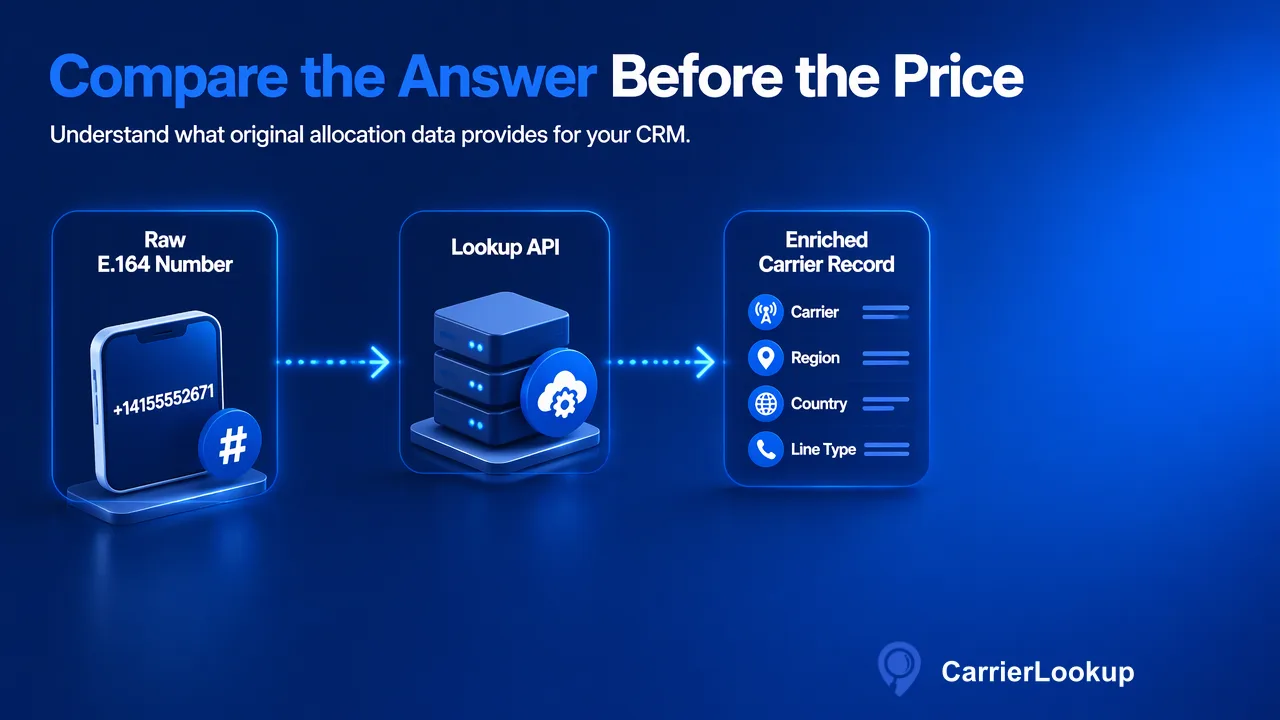
A carrier lookup purchase decision starts with the meaning of the carrier field and the workflow that will use it.
A free carrier check is useful for a small evaluation if it answers the same question as the paid service you plan to use. First determine whether the field means the network originally allocated a number range or the network serving a ported number now. CarrierLookup reports original allocation context; it does not track the current network. Then compare the fields, input size, access method and billing unit for your own workload. Registered users may request 100 free checks for realtime evaluation, subject to eligibility. That allowance is not a bulk-file trial or evidence that a paid workflow suits a large list.
Compare the answer, not the word carrier
A developer buying data enrichment might need to group CRM records by the carrier to which their number ranges were originally assigned. Another team might need portability data. These are different data products. Veriphone's pricing distinguishes standard and current-carrier checks, while 1Lookup describes a current-carrier offer. Their names and billing rules are not CarrierLookup terms. A low entry price for either answer cannot make it an equivalent substitute for the other.
CarrierLookup's Original Carrier Lookup reports the originally allocated carrier, underlying carrier where available, line type, country code, region and city allocation context. Porting can make original allocation different from later service arrangements. Region and city describe the allocation range, not a subscriber's location. A completed result can have empty optional carrier fields, so a sample should count useful and empty outcomes separately. The result does not prove that a number can receive calls or messages, who owns it, or whether the person consented to contact.
Write the decision plainly before comparing offers: ‘We need original allocation for grouping records,’ or ‘We need portability information for a separate question.’ If the second sentence is the task, CarrierLookup's published products are outside scope. Do not buy an original-allocation API and hope it will answer a portability question.
Match fields and access to the size of the job
For an application checking one record during a server-side workflow, the documented realtime REST single route is POST /api/v1/check. For a modest set of prepared E.164 numbers, POST /api/v1/batch-check accepts 1–100 in input order and returns synchronously. The dashboard realtime batch accepts up to 500. Realtime input uses a leading plus sign and country code without separators, and does not require a separate country choice. The API documentation is the source for the exact current request contract and error handling. Keep the X-API-Key on a trusted server.
A large prepared list has a different workflow. Global carrier lookup is an asynchronous TXT or CSV file task for prepared valid numbers from one selected country. It produces one downloadable CSV after success. Preprocessing excludes invalid, duplicate, countryless and wrong-country rows; those excluded rows are not charged, but they still matter to a buyer measuring usable coverage. The current file-size and row limits should be checked in the API documentation. This is not the same-response JSON route used for a small group.
Compare your sample against the route you would actually use in production. A realtime evaluation can test field meaning and integration; it cannot establish that a mixed-country upload will work in the one-country file workflow. Record which rows fail preparation, which are excluded, and which completed lookups return empty optional fields. Those categories affect the value of an enrichment purchase more than a generic field list.
Understand free checks, permanent balance and recurring plans
CarrierLookup states that registered users can request 100 free checks. Confirm eligibility before planning around them. They apply to realtime checks and do not by themselves make a bulk file task eligible. A useful small evaluation includes a few known allocation cases, permitted records with different line types and cases where fields might be unavailable. Keep your own reference labels and observe what the documented output actually says; do not call the sample an accuracy study for every country.
For paid use, both published service types share a USD balance and charges are based on completed numbers. A successful completed lookup can be chargeable even when all carrier fields are empty. Failed or undetermined lookups do not retain a charge. Bulk tasks reserve an estimate and reconcile unused funds to the same wallet; this is distinct from a customer-requested refund of a purchase. Review the current pricing page at purchase time for the payment and balance associated with each option.
The commercial choice is between non-expiring permanent top-ups and optional auto-renewing 30-day plans. Plan balance is used before permanent balance. Turning off auto-renewal prevents future plan charges, but does not reverse prior payments. Instead of comparing the headline payment alone, estimate the number of completed checks your authorized workload needs, consider which wallet balance will be consumed first, and decide whether recurring billing matches that pattern. No provider's credit unit should be assumed equivalent until its measured signal and completed-check rule are clear.
Run a small evaluation before committing to volume
Choose a permitted, representative realtime sample and record each number's source, expected original allocation where independently known, country, returned field availability and check date. Include a few cases with independently known original allocation, if your team has that evidence. Judge the returned field against that allocation question, not a later service arrangement. Separate malformed input from a completed lookup with blank fields, and keep undetermined outcomes in a third category.
The evaluation should answer three buying questions: does the original-allocation meaning fit the CRM decision, are the available fields sufficient, and can the team handle empty or excluded rows without turning them into false negatives? Only then select the realtime or file path, estimate completed-check usage and review the current balance option. Use the API documentation and pricing page for the current contract before implementing or buying.
Learn More
Choose the product information that fits the next step in your workflow.