
Carrier Lookup by IMEI vs by Phone Number: What Each One Tells You
A carrier lookup by IMEI and a carrier lookup by phone number start with different identifiers and answer different questions. An IMEI identifies cellular.
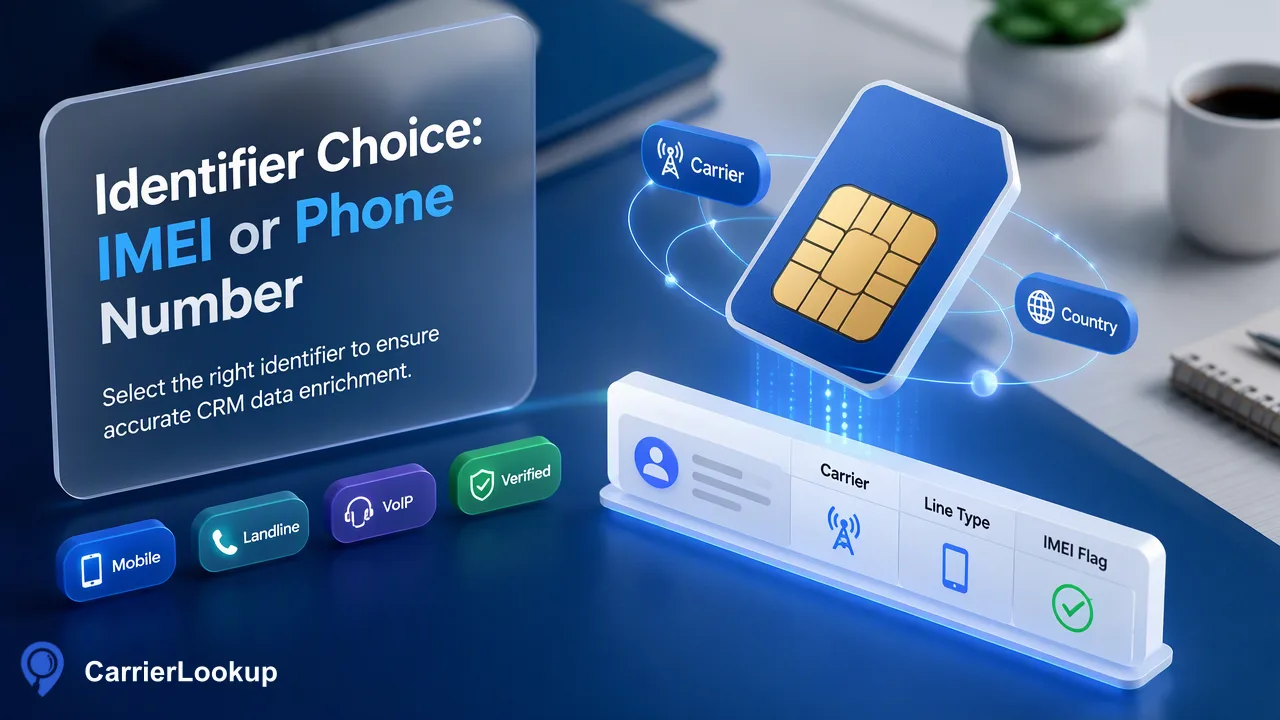
A carrier lookup by IMEI and a carrier lookup by phone number start with different identifiers and answer different questions.
A carrier lookup by IMEI and a carrier lookup by phone number start with different identifiers and answer different questions. An IMEI identifies cellular equipment; a phone number identifies a numbered subscription endpoint for a number-range lookup. CarrierLookup accepts phone numbers and reports the carrier to which a range was originally allocated, along with number type and allocation geography when available. It does not accept an IMEI or report device condition. If a team has contact numbers in a CRM, use a number lookup. If it has physical handsets to assess, use an appropriate device-specific process and keep those results separate from contact enrichment.
Carrier lookup by IMEI vs phone number: identify the object
The GSMA Device Check FAQ defines an IMEI as an electronic serial number for cellular equipment. It also explains that device checks use the equipment identifier. A phone number is a different identifier: it is the string a team stores to address a telephone service. The number can remain in a contact list even when the handset changes. A handset can be replaced without changing the number, and an organization may manage several numbered subscriptions across devices. Therefore a device question cannot safely be answered by treating a phone number as an IMEI, or vice versa.
Write the question before choosing a lookup. “Which device is this?” points to an equipment identifier. “What is the original allocation context of this telephone number?” points to a phone-number lookup. “Which person currently uses it?” requires evidence outside either simple identifier. This distinction helps operations teams avoid joining a device status to a contact record just because both appear near the same number in an export.
What a number-based carrier result actually means
The Original Carrier Lookup API uses a phone number in E.164 format and returns original carrier context. Carrier is the operator to which the number range was first allocated, not necessarily the network currently serving a ported number. Number type and, when available, region and city describe the range classification and allocation geography. These values help a data team organize records by numbering context. They do not identify the handset, its IMEI, a device owner, the current location, or whether a message will be received.
For a new contact record, a single realtime lookup can populate dedicated original-carrier and number-type columns. A synchronous multi route fits a small intake batch and preserves result order for reconciliation. A large historic list may fit an asynchronous file task. Choose the route according to list size and workflow timing, not according to a desire to infer device facts. The API documentation gives the current route details and product-specific limits.
What an IMEI check can and cannot replace
A device check is appropriate when the organization actually has the handset identifier and a legitimate device assessment question. GSMA describes its Device Check status in terms of whether the identifier is flagged on its block list. That is an equipment-focused status, not a carrier-allocation answer for a CRM phone number. Conversely, an original carrier result does not say whether equipment has been lost, stolen, or altered. Neither result should be stretched into a person-level assertion.
A useful intake rule is to keep two typed fields: phone_number_e164 for number workflows and device_imei for equipment workflows. Do not put an IMEI into a number input because it contains digits. Do not reconstruct an IMEI from a phone number or infer that a particular handset is attached to the number now. If a workflow needs both, collect each identifier through its own authorized source and record when and how the association was established. That association can change, so attach a timestamp and a source reference rather than treating it as a permanent identity fact.
Decision guide for teams with lists, devices, or both
For a CRM list containing telephone numbers, normalize the numbers, preserve source record keys, and run a number lookup. Store original carrier, underlying carrier, number type, and allocation geography in separately labeled columns. Keep an empty field as unavailable, and keep input rejection distinct from a completed result. This produces context that can be reviewed without pretending it reflects a device.
For an asset inventory of handsets, collect IMEIs through the organization's device-management process and use an equipment-specific source. Store the result against the asset key. If the asset inventory also contains an assigned telephone number, maintain the assignment as a separate relationship with effective dates. A SIM swap, handset replacement, or number reassignment can break that relationship without changing the historical lookup output.
When analysts combine both datasets, require them to state the decision each field supports. Original carrier can inform grouping and review; equipment status can inform a device decision. Neither field by itself proves ownership, consent, reachability, or current location. Separate provenance is the practical safeguard against turning two limited signals into one unsupported conclusion.
For a shared data model, document who owns the assignment between a device and a phone number. An asset team may know the handset, while a CRM team knows a customer-provided number. Neither table alone proves that the pairing remains current. Review the assignment when a device is replaced, a subscription is reassigned, or an employee leaves. Store the effective date and evidence source so an analyst can use an older lookup for its intended historic question without presenting it as a current device fact.
FAQ
How can teams choose the right identifier for a contact export?
Inspect what the export actually contains. A telephone number belongs in a number-based carrier lookup after E.164 normalization. An IMEI belongs in an equipment-specific process. If the file has only phone numbers, do not invent or derive device identifiers. Preserve the record key so each number result can be joined to the correct contact without claiming a verified person or device association.
Can an IMEI reveal the originally allocated carrier of a phone number?
An IMEI is an equipment identifier, while an original-carrier lookup is based on a telephone number range. A device check does not replace a number-allocation lookup. If a process needs both pieces of information, collect the number and IMEI separately, evaluate each through the suitable source, and record the evidence linking the device to the subscription at that time.
Does a carrier result identify the handset used today?
No. Original carrier, number type, and allocation geography describe the number range. They do not provide the current handset identifier or device condition. A phone number can be associated with different equipment over time, so teams should keep device inventory and number enrichment as separate datasets with their own update dates and sources.
Learn More
Choose the product information that fits the next step in your workflow.