
Canada Phone Number Carrier Lookup: Reading Shared +1 Numbers
Learn how to prepare Canadian +1 numbers, distinguish them from other NANP records, and read original carrier and allocation geography.
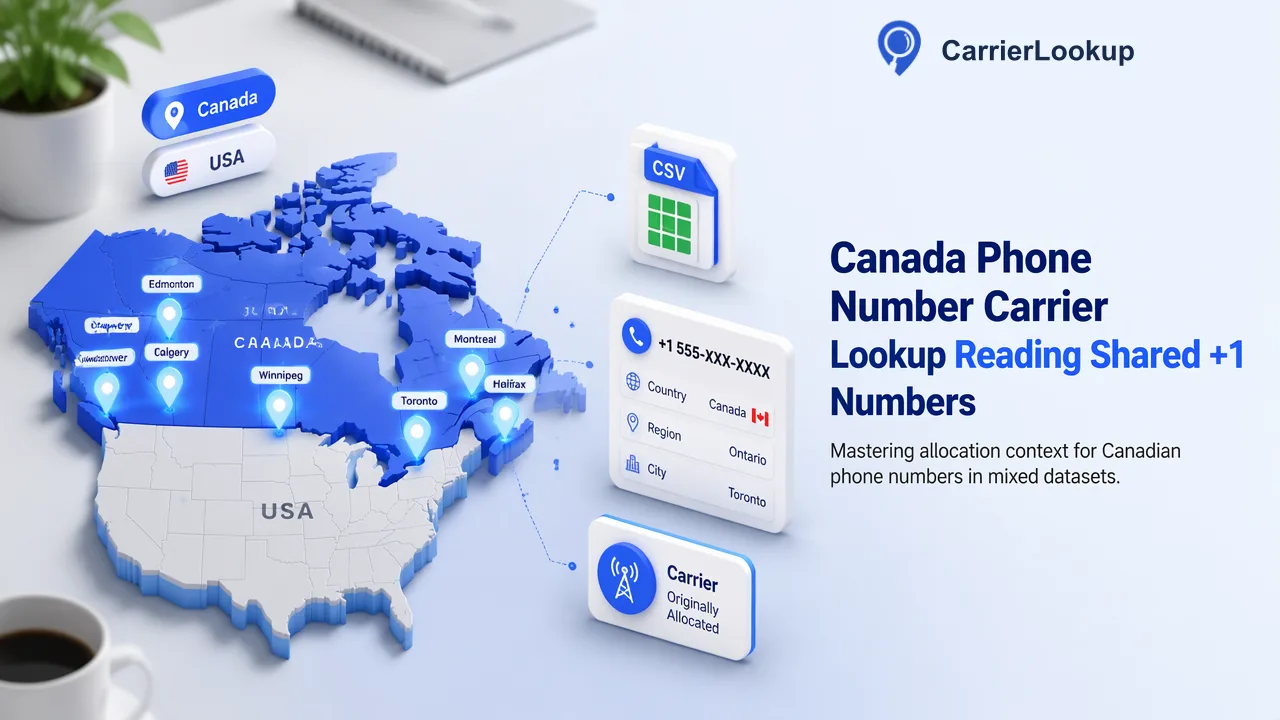
A Canadian carrier lookup workflow that handles shared +1 numbering and keeps bulk country selection separate from realtime input.
A Canada phone number carrier lookup starts with a properly prepared +1 number, but the +1 prefix alone does not identify Canada. Canada participates in the North American Numbering Plan alongside the United States and other members. For realtime CarrierLookup checks, submit the country-coded number directly; a separate country selection is unnecessary. For a bulk file task, verify the destination country of each prepared record and select the matching ISO country. Read carrier and geography as original allocation context, not live network or personal location.
Why a Canadian phone number is more than the +1 prefix
The Canadian Numbering Administrator explains that Canada is part of country code 1 and the North American Numbering Plan. The North American Numbering Plan Administrator lists other participating countries and territories under the same country code. Thus a database rule that classifies every +1 record as Canadian will mix countries. A Canadian workflow needs the full number and a reliable country classification method for its own records; it should not infer country from the leading digit alone.
Keep the original source country, the normalized number, and the method used to classify the record. For a CRM whose customer address says Canada, that address may help a human review a number, but it should not silently override conflicting number evidence. If classification is uncertain, put the row in a review queue before a country-specific file task. The goal is a defensible input set, not a perfect guess from a prefix. If a source system stores only ten digits, establish the intended country before adding a dialing prefix. A formatting step cannot recover a country that the source never recorded.
This distinction matters most with a mixed North American export. Two rows may both begin +1 yet belong to different selected countries for a bulk task. Keep a manifest with the count of confident Canadian rows, confident non-Canadian rows, and unresolved rows. That manifest gives operators a clear explanation if the eventual output does not cover the entire original list.
Choose the right realtime lookup route for Canadian records
The Original Carrier Lookup accepts a country-coded E.164 number with a leading plus sign and no spaces or separators for a single realtime check. Its synchronous multi route handles a set of numbers from different countries and returns results in input order. The dashboard provides a separate realtime batch path. These routes do not require a country selection for each Canadian number. A mixed +1 list can therefore be checked through the documented realtime route when the team needs synchronous results, subject to that route's limits in the API documentation.
Prepare inputs deliberately. Retain the raw phone field, a normalized E.164 value, and the source row ID. Reject or review values that cannot be normalized confidently. A rejected format is not a lookup finding that no original carrier exists. If a team sends several values together, keep an index from each submitted identifier to its source row. Verify the returned order and outcome before updating records. An empty optional field in a completed result should stay unknown; it should not be replaced with an assumed Canadian operator.
The word realtime describes this request-and-response path. It does not mean that the returned carrier is the network currently serving a ported number. Canadian mobile number portability makes that distinction especially important for analysts who are accustomed to reading a carrier name as present service. State the column meaning wherever the result is exported or shown to a reviewer.
Prepare a Canada-focused bulk file without mixing countries
For a larger back catalogue, Global carrier lookup uses an asynchronous TXT or CSV file task. Its file is one column of country-coded numbers, with one selected ISO country for the task. Assemble a list that is essentially for that selected country. Do not submit every +1 number from an international CRM under Canada merely because the prefix is shared. Separate confident Canadian records from US or other NANP records, and keep ambiguous entries for classification review. The product's documented preprocessing may exclude out-of-country rows, uncoded numbers, invalid entries, and duplicates, but a clean input is still the team's responsibility.
Build an acceptance manifest before upload: source rows, normalized Canadian candidates, unique prepared identifiers, excluded rows, and unresolved country classifications. For each prepared number, retain the original source IDs in a sidecar mapping. This preserves duplicate contacts even though the file task can exclude duplicate numbers. Check current product limits and acceptance conditions in the documentation. Do not pad a list with unrelated numbers to reach a task size. If a task fails during preparation, investigate its acceptance report rather than treating all source rows as a negative carrier answer.
On success, download the single CSV and reconcile its identifier to the sidecar mapping. The bulk identifier is country-coded digits without a plus sign or spaces, so compare normalized keys while retaining the raw output for audit. Compare returned and excluded counts to the prepared manifest. Any unmatched row should remain unresolved until a person or a reliable rule explains it. The file task is asynchronous and should be polled no more often than the documented interval.
Read Canadian carrier and geography as allocation context
The result can include original carrier, underlying carrier, number type, country code, region, and city allocation fields. The original carrier is the organization to which the number range was originally assigned. A ported number may be on a different serving network now. Underlying carrier is a separate returned field when available; do not collapse it into a guess about current service. Region and city describe allocation geography of a number range. They are not a location ping and cannot establish where the subscriber, device, or contact is today.
An analyst can use these fields to group Canadian source records, review suspicious input classifications, or compare coverage of original-allocation data. If the result is empty, report it as unavailable rather than mapping it to a familiar local operator. A completed lookup with empty optional carrier fields still has a distinct completed outcome. A synchronous multi item with no normal result is a different state. Keep those states separate in any Canadian coverage report.
This lookup also does not determine whether a number is active, reachable, owned by the CRM contact, or authorized for outreach. Those questions require their own evidence and controls. In a downstream report, label the dimensions original carrier, number type, and allocation region; include check date, source service, and count of unresolved rows. This makes the output useful for data operations while preventing a shared +1 prefix or an old allocation record from being mistaken for a present-day network fact.
FAQ
How can teams separate Canadian and US numbers when both begin +1?
Use the full number and a documented country classification process, not the country-code prefix alone. Keep source-country evidence and flag ambiguous rows before country-specific file preparation. Realtime checks can accept numbers from different countries, while a file task has one selected country and should contain a list essentially for that country.
Can a Canadian lookup show the carrier after a number was ported?
The returned carrier describes original number-range allocation. It should not be relabeled as a current serving network after porting. Store the field with its original-allocation meaning and check date. If an operational decision requires current service information, obtain evidence from an appropriate separate source rather than inferring it from this lookup.
What does an allocation city mean for a Canadian number?
It describes geography associated with number-range allocation when that field is available. It does not show where the person lives or where the device is now. Keep the label explicit in CRM reports and leave an empty city unavailable. Avoid filling it from a mailing address or assuming that a matching city proves contact identity.
Learn More
Choose the product information that fits the next step in your workflow.